Economic riding is his specialty: how Alec Segaert wins races without top power
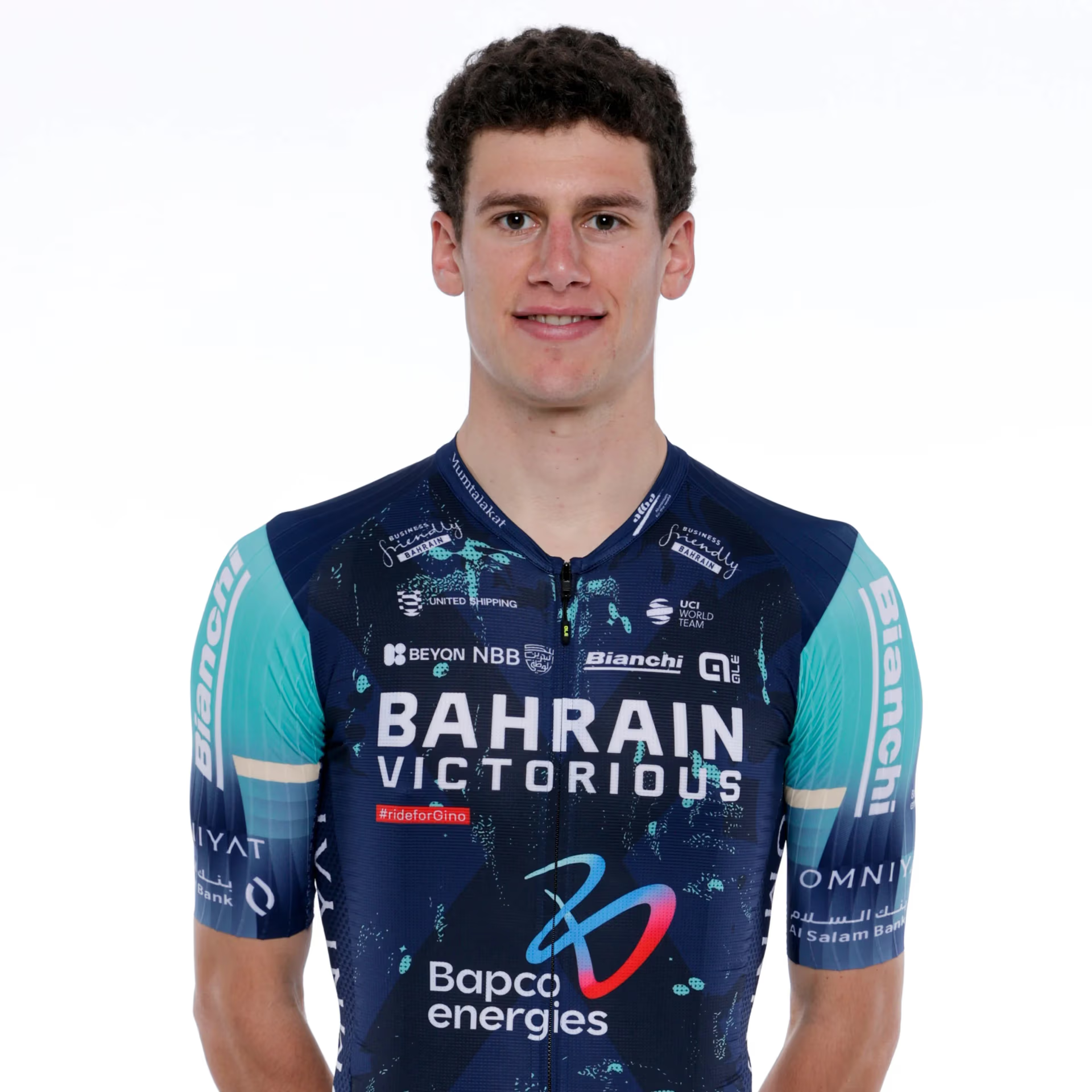
Still, a Belgian stage win in the Giro d'Italia! In true Segaert style, Alec broke away three kilometers from the finish in stage twelve and then just barely stayed ahead of the peloton. Everyone knew the strong rider might try it there, but brother and Bahrain Victorious performance coach Loïc Segaert sees several reasons why it worked out so well.
Loïc rode ahead with Miguel Martinez, father of teammate Lenny, in the team car doing the route reconnaissance. "We tried to describe in as much detail as possible to the team directors what was coming up. Then Alec just made the perfect move. We were pulling into the team parking lot just as he launched the attack. So we just pulled the car to the side to watch the last kilometers and see him win," Loïc told us enthusiastically.
What was the recipe for success?
"If you ask Alec, he says: 'I'm not the strongest, but I’m good at riding a bike really hard.' That’s exactly it: he can pedal hard, but he’s not a power monster. I see that in most of the time trials he does, like last year's European Championship. I think he was about 50 watts below the rest of the top 10. But he has excellent aerodynamics and understands very well the game of carrying speed out of corners, on descents, and where to put his energy."
"It’s the same on a climb. Often, he climbs over the whole peloton with the lowest power relative to his weight. By pacing the climbs well, knowing where to gain positions and where to let some slip, he can ride economically. He does exactly the same in the classics. He's not strong enough to follow the big guns on Oude Kwaremont or Kemmelberg, but he can get up front with relatively limited energy."
So you’re basically saying: this is a victory of the mind?
"I think so, and that has always been the case with Alec’s wins. It will probably always have to be that way, especially if you want to win at the highest level. As a junior, he won many races because he was the best, but as a pro, it always has to be with a good move and perfect timing. He still has to pedal hard at that moment. Maybe in Nokere Koerse he didn’t quite pedal hard enough and missed out, but it was still a good move to attack there."
Of course, all the circumstances were on his side as well.
"That Movistar made the race so hard is what gave Alec his chance to succeed. All the teammates of the fast men had to work very hard, leaving not many left to chase him down in the finale. It also helped that the finale included some technical sections and that it went up and down with those small climbs. That pushed the riders who had worked all day further back, so they were not immediately at the front when he made his move. It was perfectly timed."
Except for Ciccone, he’s also the only one trying. Exactly what Alec said to us before the Giro: you have to want to win.
"I think many teams and riders don’t think 'out of the box' enough, no. They think: a sprint with 40 riders? We have a semi-fast guy and we’ll give him a chance. But if twelve teams think like that, that means twelve semi-fast guys occupying places one through twelve. But only one wins and eleven lose, while all those teams worked hard. Alec has the chance at Bahrain to try it himself, because we don’t have a top sprinter like Arnaud De Lie was."
Does this victory also prove he made the right move by switching to you and team Bahrain Victorious last winter?
"One hundred percent. We are a team that looks for wins. We don’t win a lot, so you can’t afford to miss those chances. If you only think it will work with your sprinter or climber: very often you won't beat guys like Vingegaard, Magnier, or Milan. There just aren’t many chances left, so you really have to dare to make something happen. We’re very aware of that. You have to approach it differently to beat those big guns. Alec is often the ideal man for that, of course."
How important is this for the rest of his career, to score a big win at the highest level?
"I think the most important thing is the extra confidence within the team. Because you’ve finished it successfully, you’ll probably get many more chances like this in the future. That even if you have a fast man on the team, you might still get to try for yourself. This shows you are a winner and gives you more freedom."
After GP Denain, this is already his second win of the season. But Alec told me before the Giro he’s not necessarily riding at higher power than at Lotto. How do you explain that as a coach?
"He’s probably a bit stronger, but it’s not a huge leap. He also weighs maybe one or two kilos less than last year, which definitely helps in uphill races if you have the same power. But it’s mainly experience, especially in the spring, that made the biggest difference. And of course the freedom from the team to be able to race."
Should he make this kind of effort more his trademark? Riders like Jelle Nijdam proved in the past it can be a specialty.
"I think it’s already kind of like that now, that people call it that. We obviously have to make sure they don’t all stick on his wheel at the wrong moment, so we’ll have to stay innovative somehow. Or even better, get a bit stronger so you can keep it. You need some luck too. If there had been a strong Filippo Ganna in that finale, he would have controlled that. Today, Alec was lucky he wasn’t there, because that could have made the difference."
In the time trial, Alec had to concede three minutes to Ganna and felt numbness in his legs. A world of difference.
"Yes, that’s something that appeared for the first time in longer time trials three years ago. It’s not a problem for him after 15 minutes of riding; in a shorter time trial, he doesn’t have any issues. Even if there’s a short descent halfway through where you can get out of position, that already helps a lot. But this time trial was just three quarters of an hour in a fixed position with almost no corners."
"We’ve made a lot of progress and now we know it’s a pinched nerve. Why it flared up again now? Maybe it’s because of just having raced for a week, everything around that nerve is a bit more tense again. We did long blocks all winter in training. Always without any problem, so there must still be a small detail we’re missing to fully control it. But luckily he doesn’t have any issues during road stages."
Finally: how proud are you as a brother?
"Super proud! But just as proud as I would be of any rider who works hard. I know what they give up, how they structure their lives and the attitude that goes with it. There are many riders who would race the spring and then realize: 'Now I do a week off, and you’ll see me again in Dauphiné or Tour de France.' But Alec is bursting with motivation and just does it anyway. Hats off!"