Giro start in Bulgaria costs teams a lot of money and effort: "It will be a start with less luxury"
A start of the Giro d'Italia outside its home country is lucrative for organizer RCS, but for the teams it always involves extra time, money, and effort. This is no different in Nessebar, on the Black Sea in Bulgaria. The Grande Partenza is about 1,500 kilometers from the Italian border, which causes logistical headaches for the teams' managers.
Such a foreign start is of course not new to the Italian race. As early as 1973, the Belgian city of Verviers hosted the Grande Partenza. The Netherlands has also been a proud host three times, but the longest transfers were probably to Belfast (2014) and Jerusalem (2018), in Northern Ireland and Israel respectively. Western Bulgaria is thus roughly the third farthest start outside Italy.
Long transfer
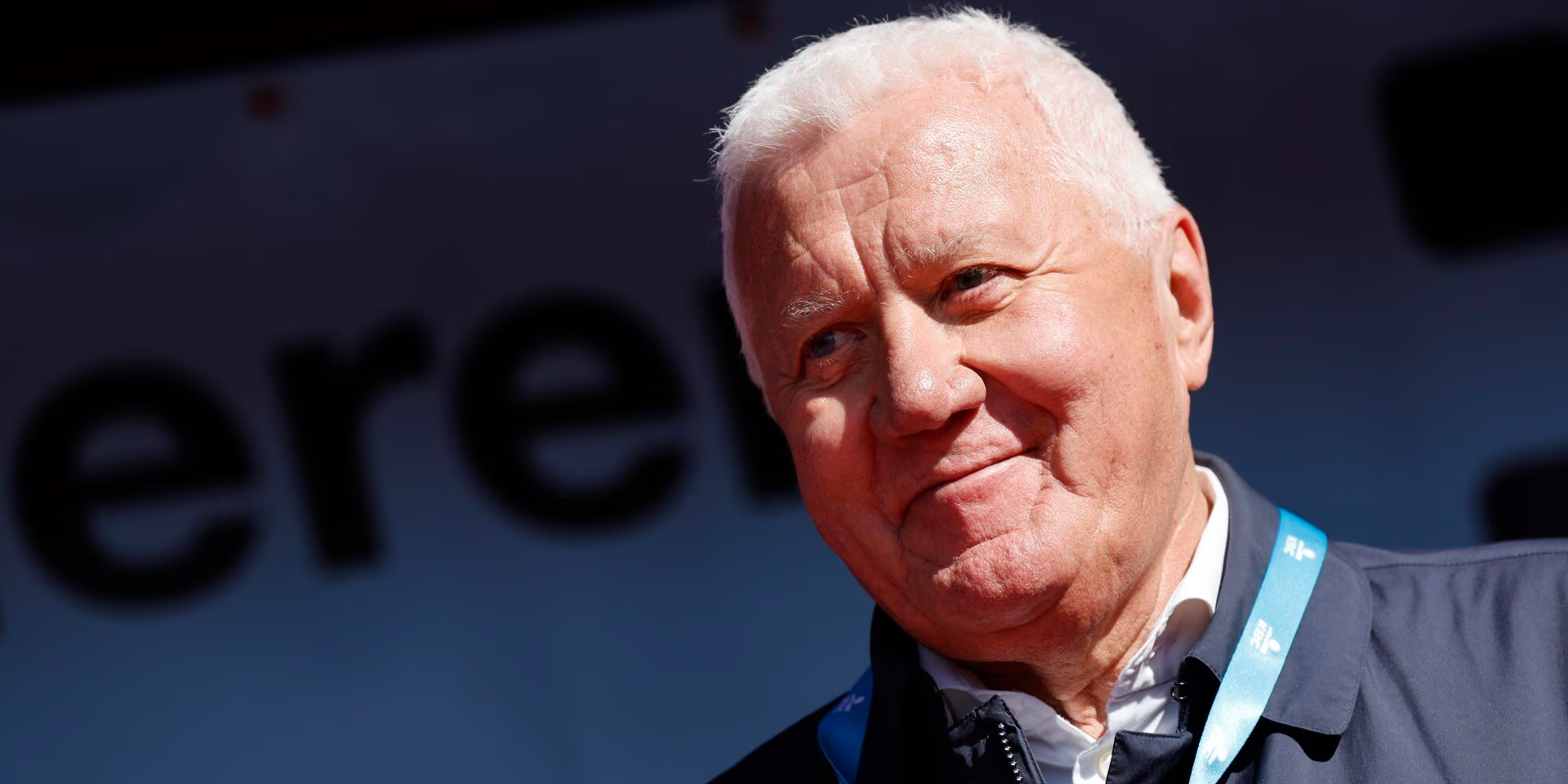
"The transfer itself was also quite challenging. That was already a big puzzle," explains Bart Wellens, the team manager at Lotto-Intermarché. From Western Europe, where most teams are based, the shortest route to get all your equipment to Bulgaria is through Serbia. But at this moment, Serbia is not part of the European Union.
"So we have to avoid that and take a detour, which adds at least 400 kilometers more. Then you have to go through Hungary and Romania, where there are lots of roadworks. The people with the buses and the team trucks have encountered many traffic jams there."
"You never know what to expect when driving vehicles through such countries. We are always relieved when it's over. That was already the case last year in Albania, but now it is even a bit tougher. Those people left several days ago to make sure they arrive on time in Bulgaria."
Besides the turbulent and costly journey, the foreign start also means the deployment of extra staff. Of course, each team has soigneurs and mechanics who fly with the riders to Italy on the rest day, but that certainly does not apply to everyone.
"We have to operate with two different teams," Wellens explains. "There is one group of people who handle only the Italian part and another group who are exclusively active in Bulgaria, because you can’t get everything to Italy in just one rest day."
Luxury items
This mostly concerns people working with equipment. The team bus, truck, team cars, and race cars must also be doubled. "Many teams, including ourselves, therefore choose to travel to the start in Bulgaria with a minimal number of vehicles. After all, it is only three days of racing there, so we manage with fewer luxuries. For example, only when we arrive in Italy do the refrigerated truck, an extra soigneurs’ car, and the mattress car join us. Then we are at full strength."
Other, wealthier teams do bring these 'luxury items' to both parts of the Giro d'Italia. Or they come up with smart solutions. For example, it is no coincidence that the Tour of Hungary next week has its strongest lineup ever with seven WorldTeams at the start. "Because they are already there, some teams go with their crew directly from Bulgaria to Hungary. That way, they combine the races and save costs," says Wellens.
In short: nearly every logistical step requires extra planning. "I will be relieved when on day four we reach the Italian mainland. Then the worst of the logistics is behind us and the stress can ease a bit," says Wellens. "It was a difficult start to organize as a team this year, with a lot of coordination. But remember: even on the mainland, the Giro involves a lot of transfers."