Tour 2026: Early Pyrenees Challenge, Two Time Trials, and Double Alpe d'Huez Climb
In Paris on Thursday, the full route of the 2026 Tour de France was unveiled. As has long been known, the 113th edition of La Grande Boucle starts in the Spanish city of Barcelona. In the following three weeks, the riders will quickly face several Pyrenean stages, pass through the Massif Central, Vosges, and Jura, and the Alpe d'Huez will be on the menu not once, but twice.
The 2026 Tour de France at a glance
The Tour de France starts in France for the first time since 2021
21 stages
6 sprint stages
5 hilly stages
8 mountain stages
5 uphill finishes
1 team time trial
1 individual time trial
Passages through the Pyrenees, Massif Central, Vosges, Jura, and Alps
Two consecutive finishes on Alpe d'Huez
The riders will cover 3,333 kilometers
54,450 meters of total elevation gain
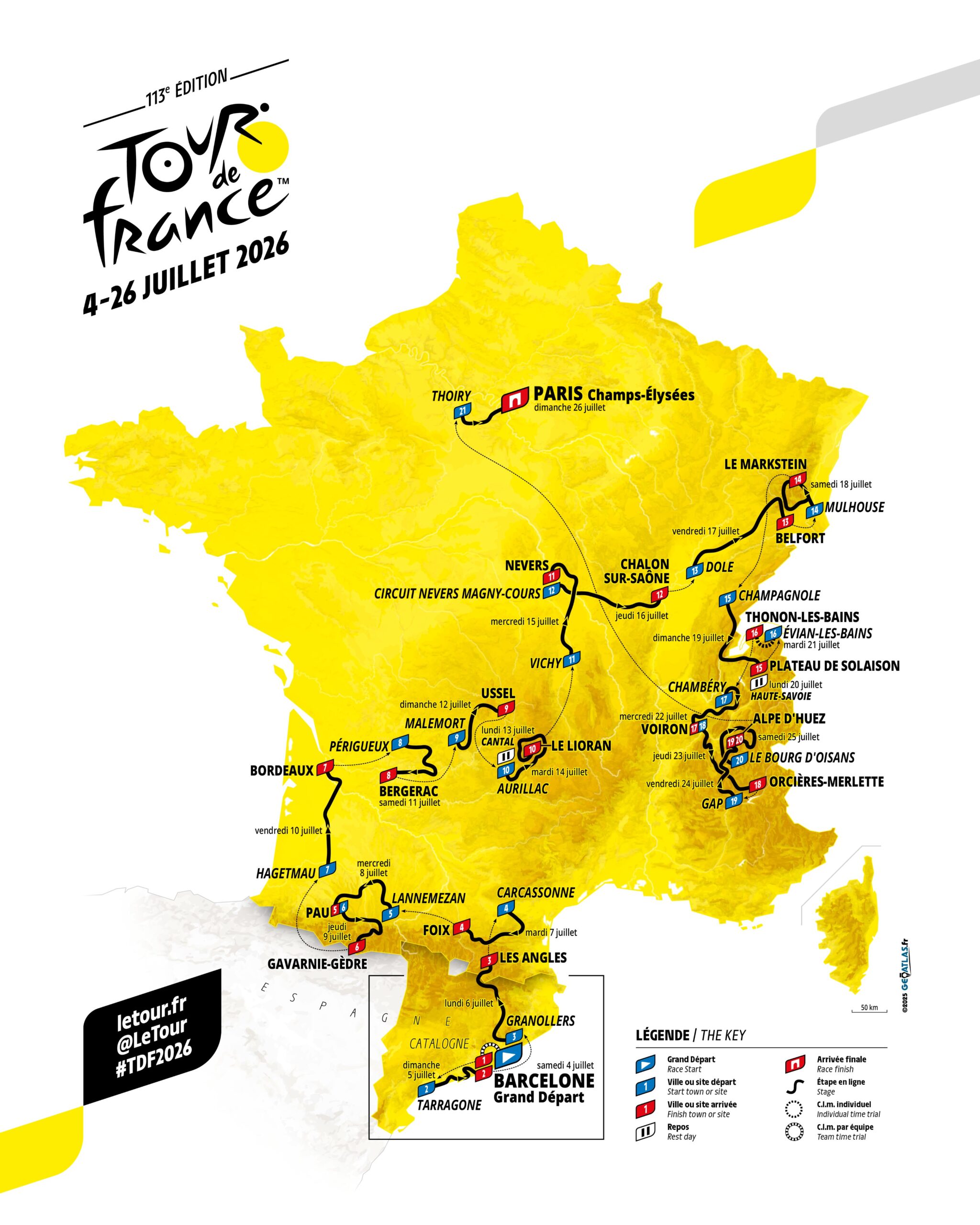
Spanish opening weekend
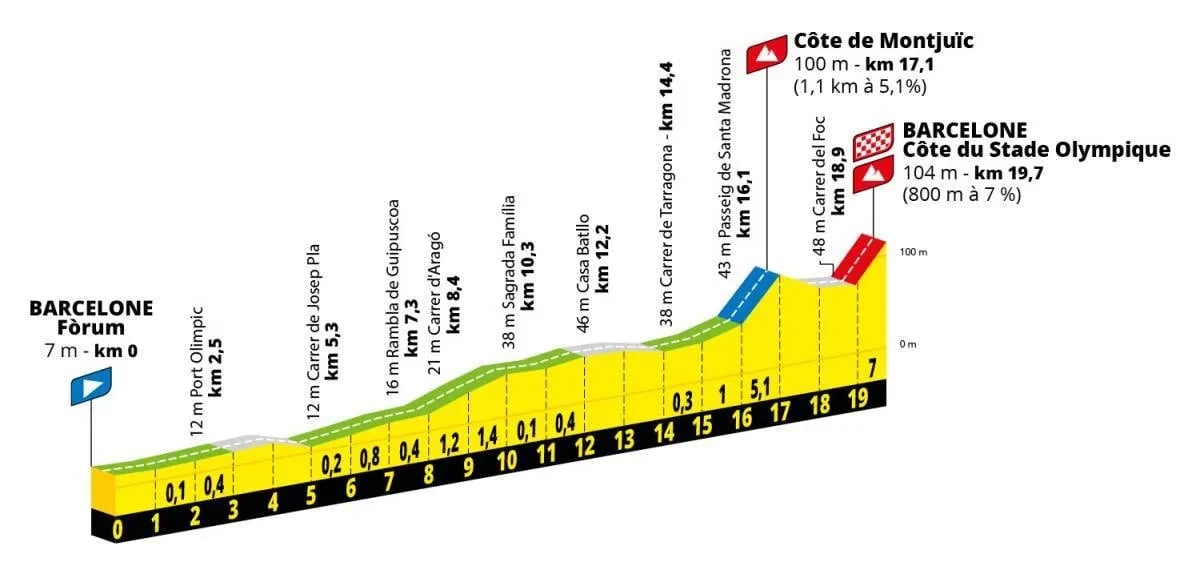
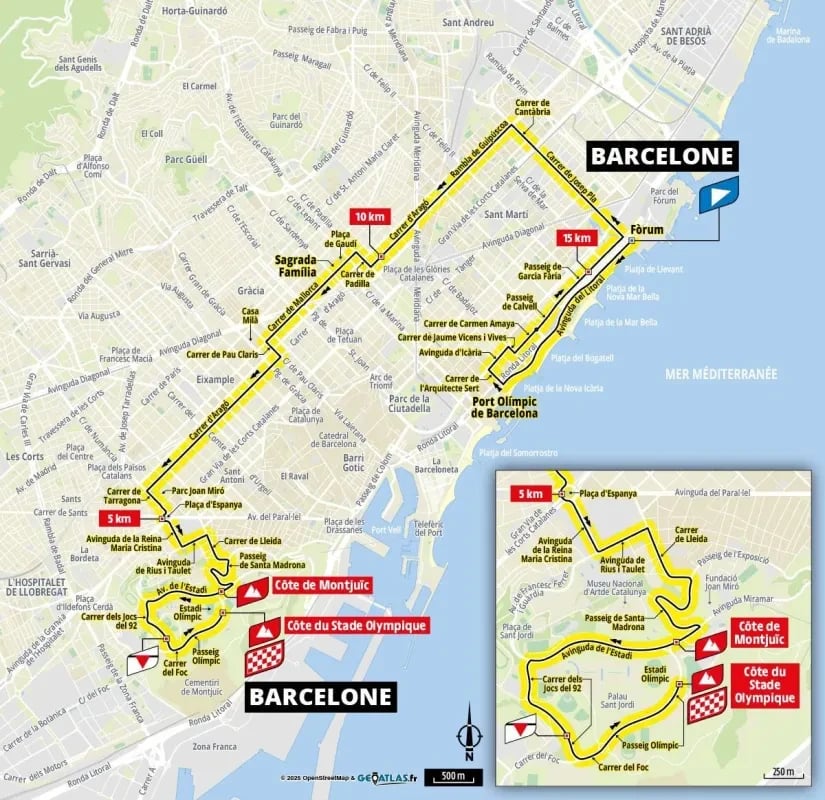
In Paris, the full itinerary for the upcoming Tour de France was revealed, but the first two stages had been set for some time. After this year’s Grand Départ in Lille, the ASO is again looking for an opening weekend outside French borders. In Barcelona, the race kicks off on Saturday, July 4, with a team time trial according to the ‘Paris-Nice rules’. The individual times of the riders will count.
The TTT passes by the world-famous Sagrada Família basilica — on relatively flat roads — but in the final three kilometers, riders tackle two ascents of the well-known Montjuïc hill. The finish line is drawn in front of the Olympic Stadium Lluís Companys, following a tough section (800 meters at 7%) of Montjuïc.
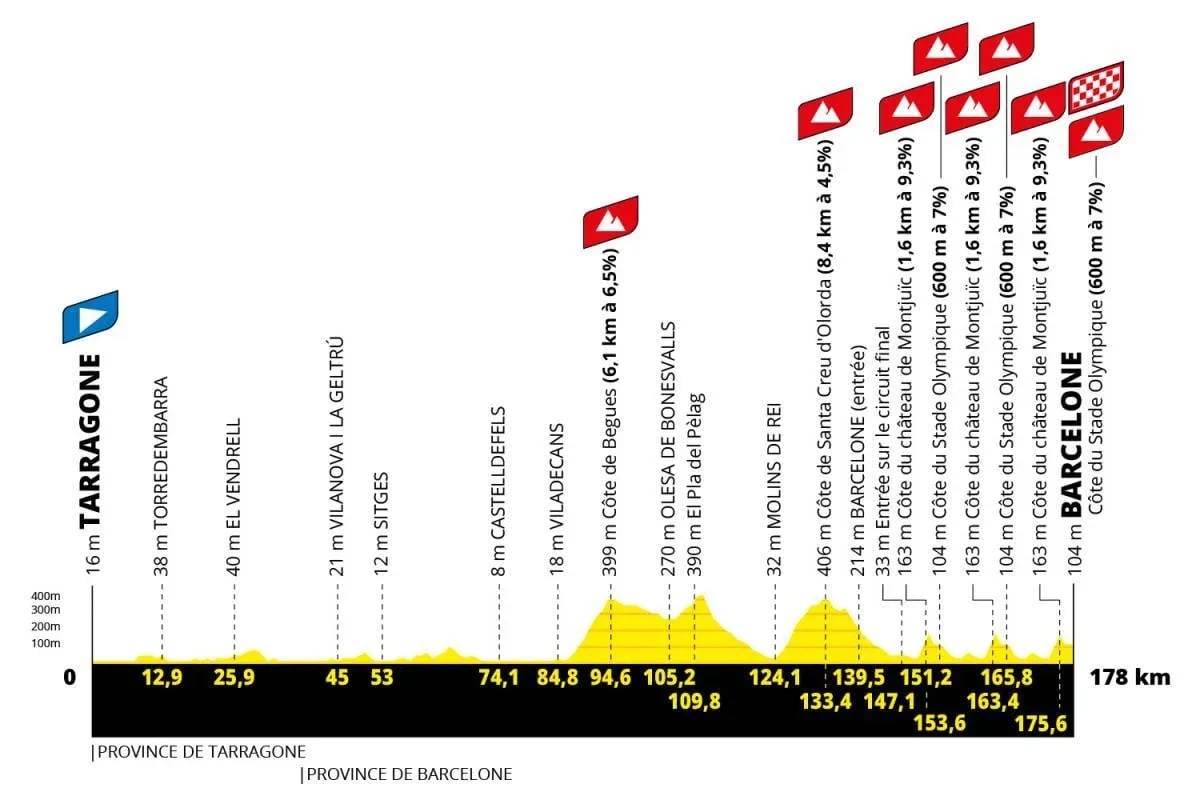
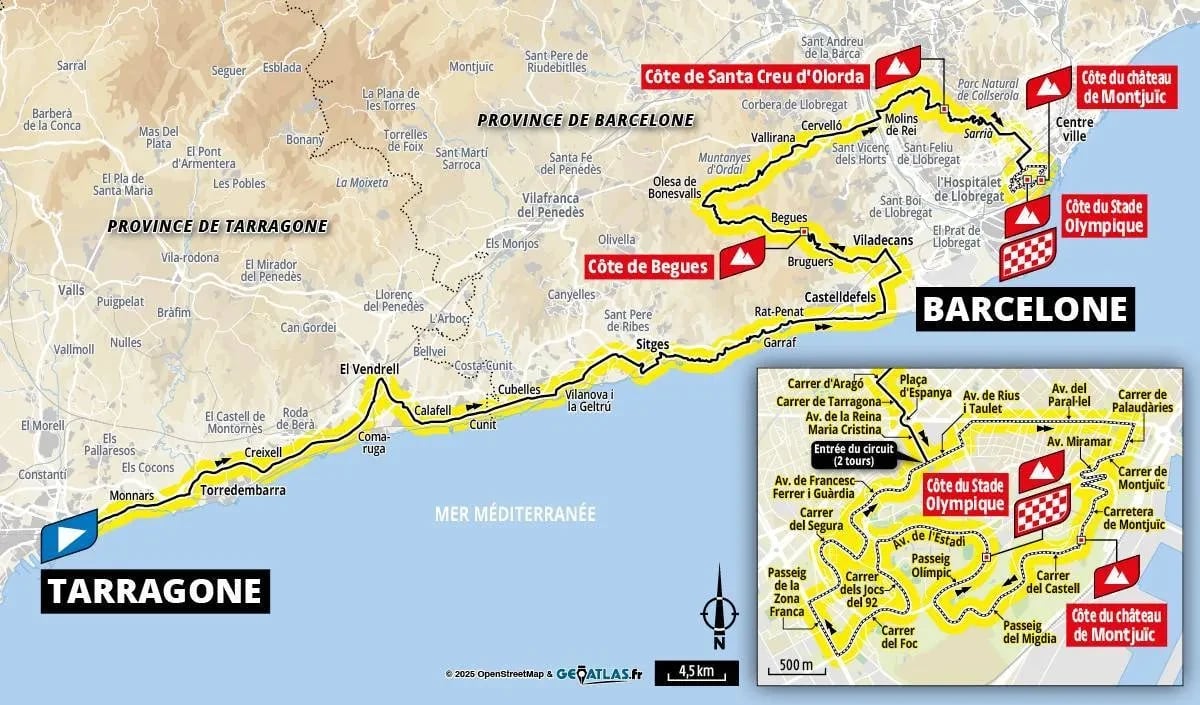
The first road stage from Tarragona to Barcelona suits puncheurs, as the finale features a rapid succession of short and steep climbs. After the Côte de Begues (6.1 km at 6.5%) and Côte de Santa Creu d’Olorda (8.4 km at 4.5%), Montjuïc — just like in the team time trial — will play the role of a decisive test. The ascents to the Montjuïc castle (1.6 km at 9.3%) and the Olympic Stadium Lluís Companys (600 meters at 7%) make three appearances in the finale.
Pyrenees loom early
Barcelona is only about 200 kilometers as the crow flies from the first Pyrenean cols, so it's no surprise that the Tour caravan enters this rugged mountain range right after the opening weekend. The third stage will come down to the finale towards Les Angles near the ski resort of Pla del Mir. A heavy final climb is still avoided at this stage of the race, but already early in the three-week race some serious elevation gain will be ridden.
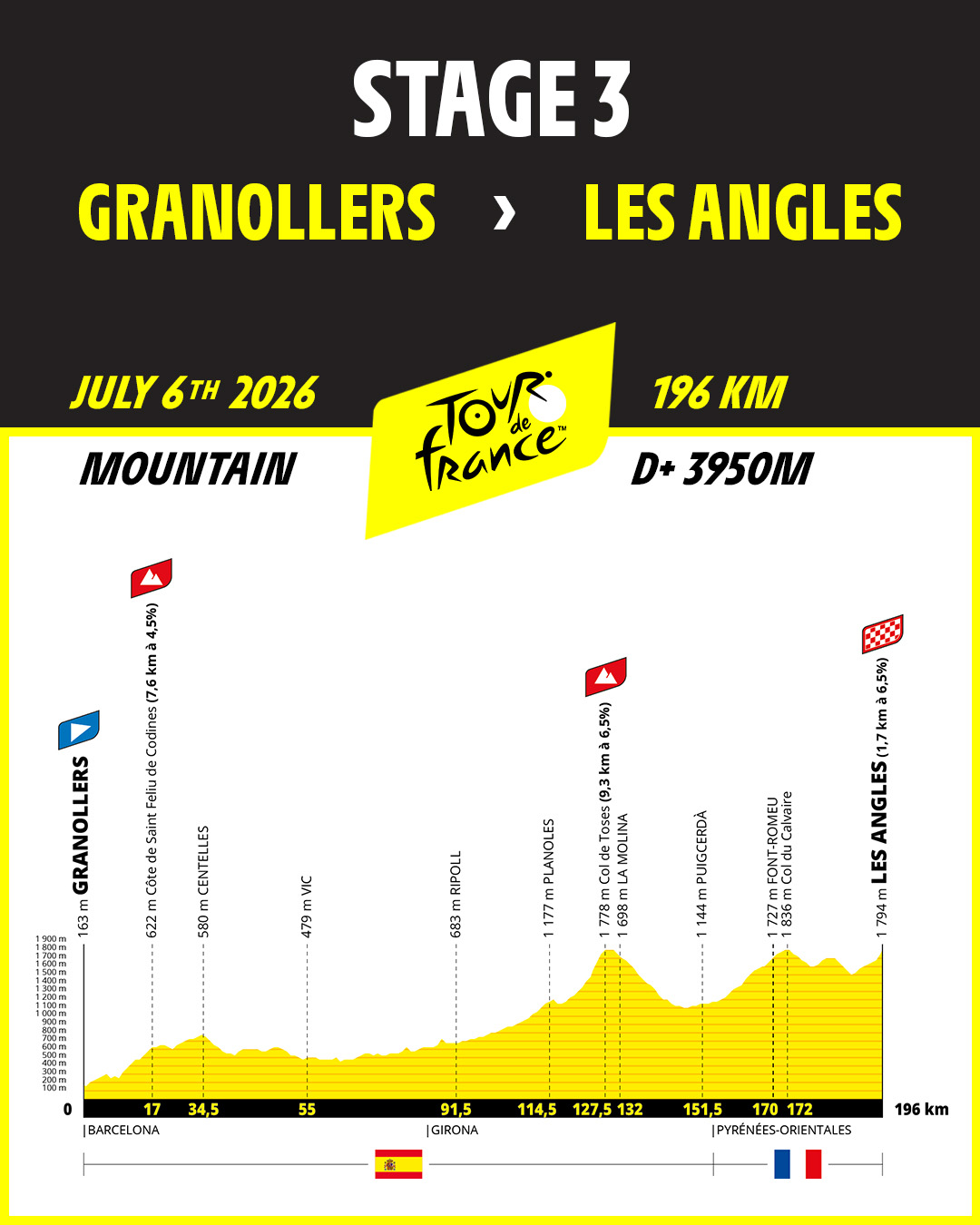
Pla del Mir has never been a Tour de France finish, but in 2022 it hosted the Route d’Occitanie. The now-retired Michael Woods arrived solo in the ski resort at 1,840 meters altitude. The main climb is 2.8 kilometers at 6.8%, but you have to climb quite a bit just to reach its base, so we can already expect some attacks and — who knows — time gaps between GC contenders.
The third stage to Les Angles is not the only confrontation in the Pyrenees. On day four, the peloton heads to the Ariège department for a transition stage with 2,750 meters of elevation, featuring the Col de Coudons and the Col de Montségur as obstacles on the way to the finish in Foix. The fifth stage offers sprinters a chance to shine, as the route to Pau — a quintessential Tour city — is flat.
In the following stage, the fast men will mostly try to survive, as stage six crosses the Pyrenees again, including the famous Tour cols Col d’Aspin, Col du Tourmalet, and an uphill finish in Gavarnie-Gèdre, totaling 4,150 meters of climbing.
After this Pyrenean section, the ASO will skip the many climbs for a moment, making way for two sprint stages, unless the wind stirs up some action. By then, riders will be craving the first rest day, but first, there is a stage heading to the familiar Tour city of Bordeaux, after crossing the well-known Dordogne wine region, followed by a stage ending in Bergerac. The final stage before the rest day covers very hilly terrain (3,300 meters elevation) towards Ussel.
Passages through Massif Central, Vosges and Jura
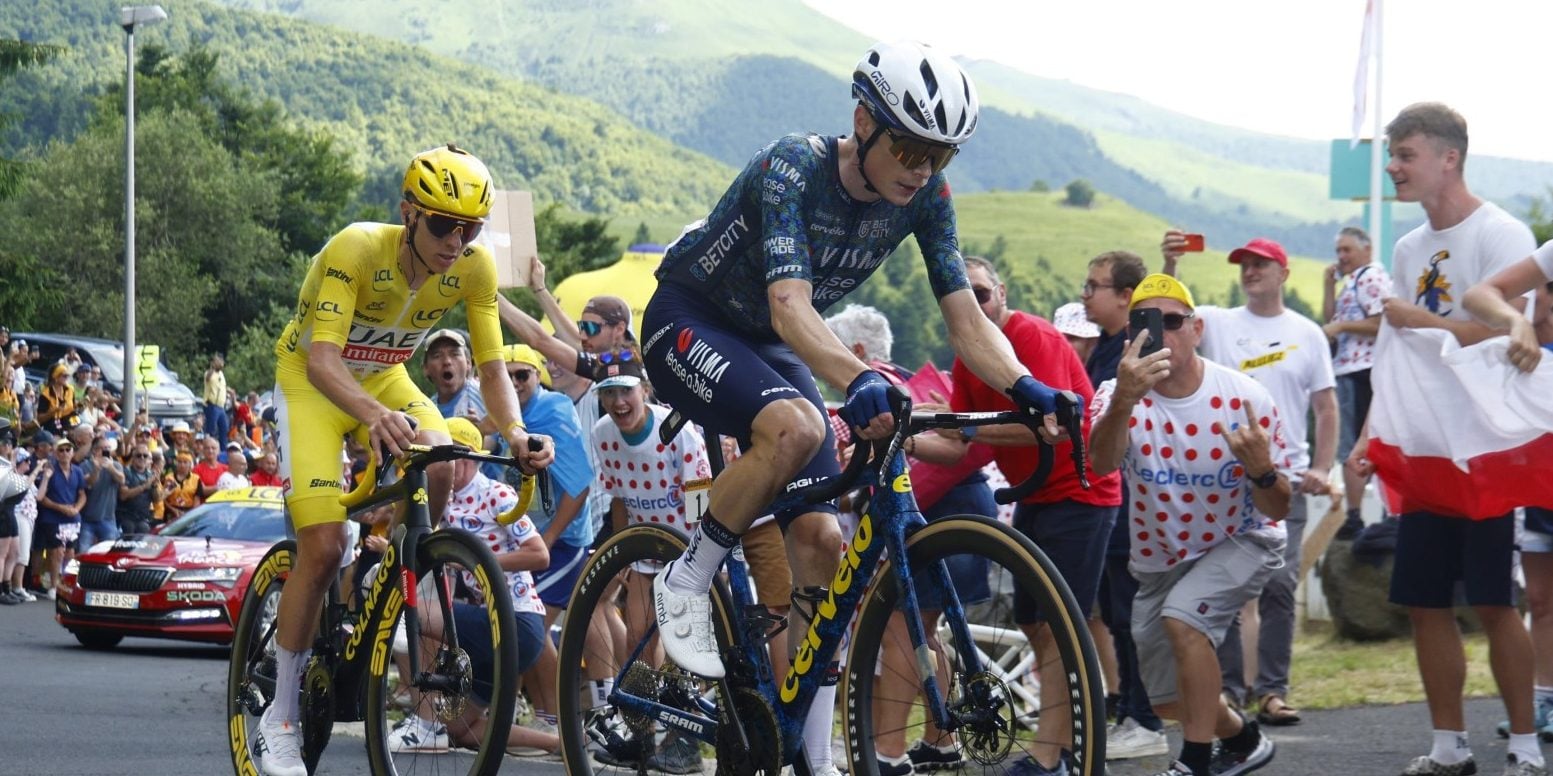
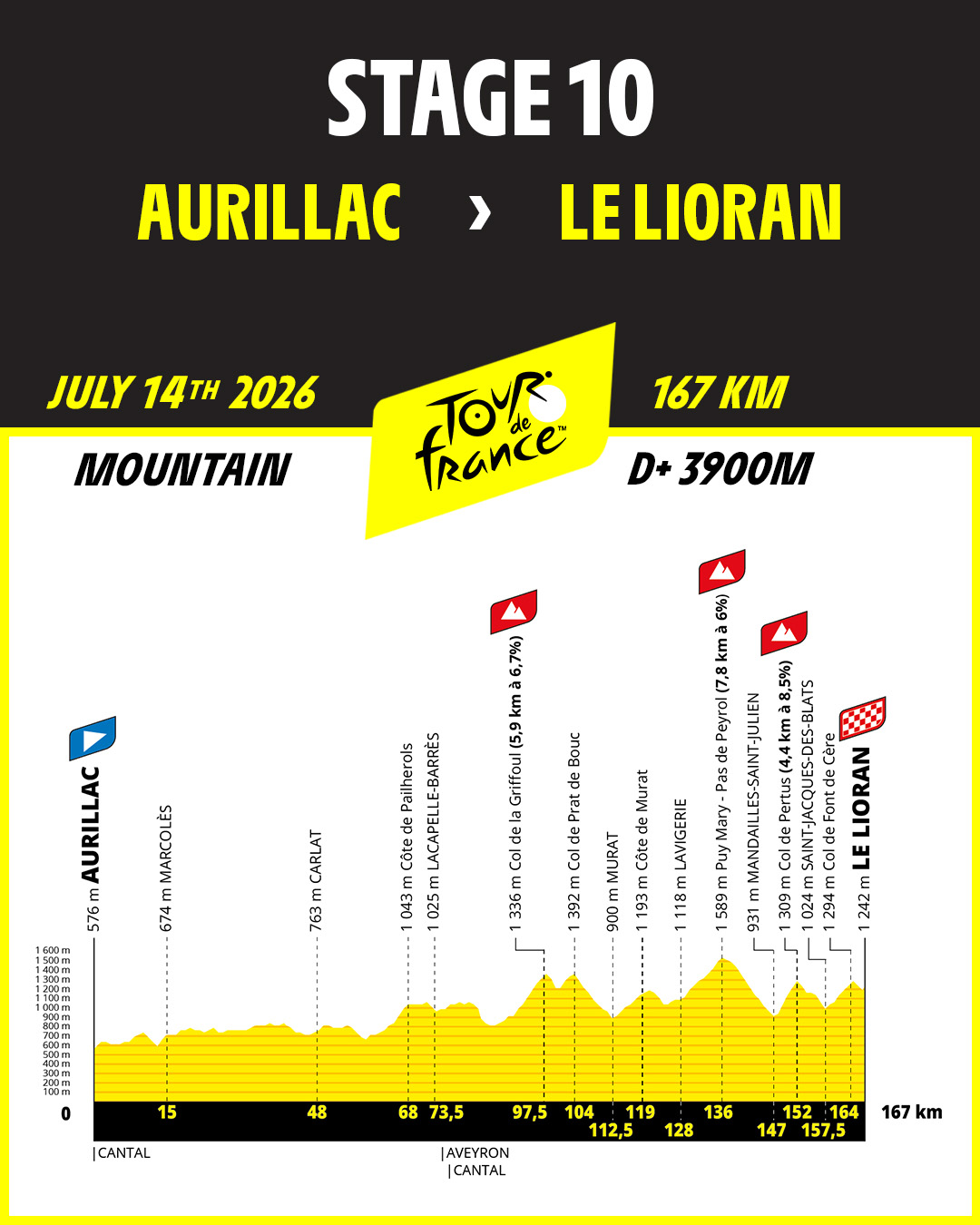
The day after the first rest day, the GC riders will be tested once more, as the Tour returns on the French National Day (July 14) to Le Lioran. This not-to-be-underestimated stage starts in Aurillac and crosses several climbs, including the Pas de Peyrol (5.4 km at 8.1%). In 2024, Tadej Pogačar launched his attack on this climb en route to Le Lioran.
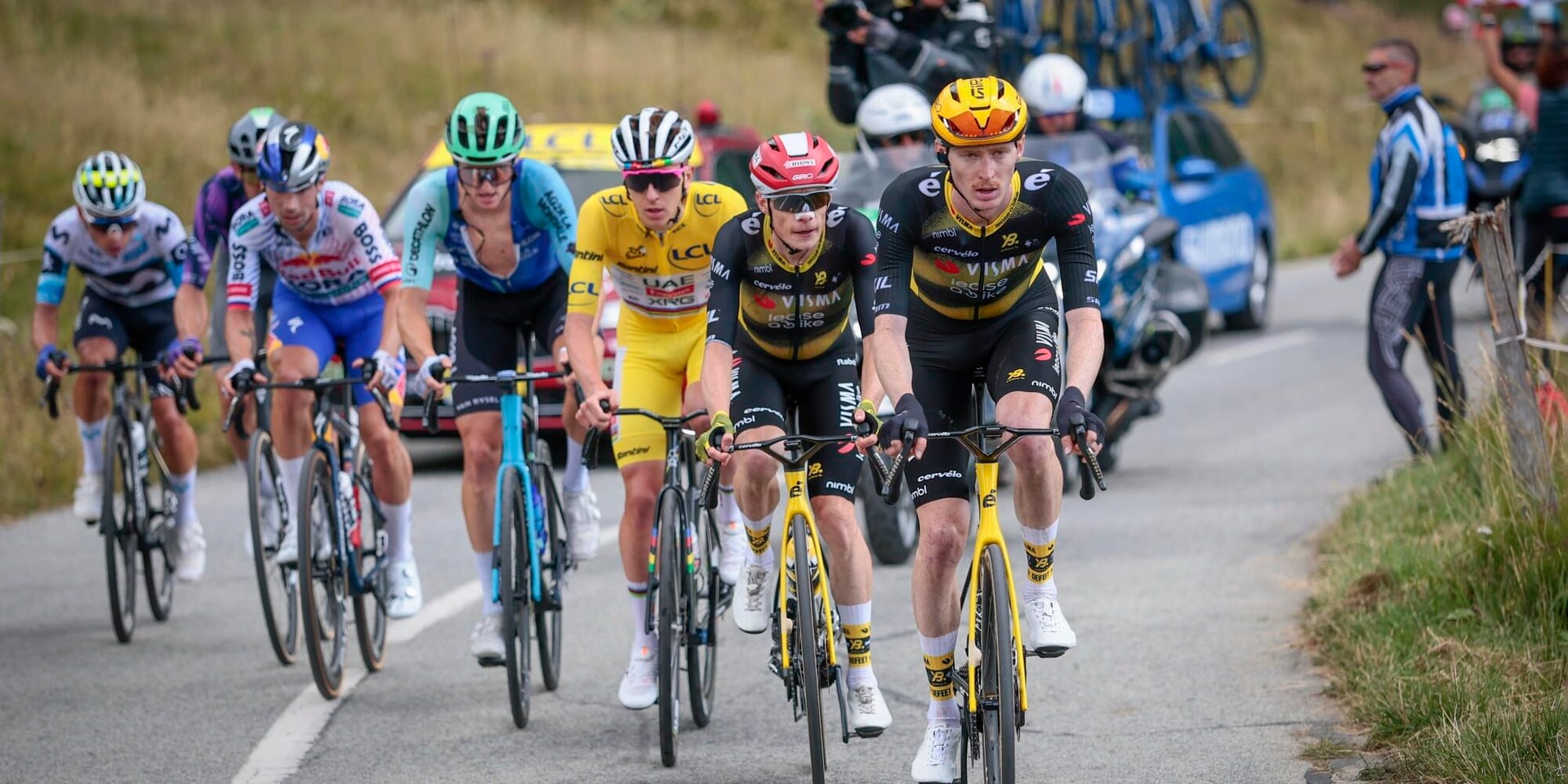
The Slovenian seemed on his way to another impressive solo, but on the next Col du Perthus (4.4 km at 7.9%) he was caught by Jonas Vingegaard. After also tackling the Col de Font de Cère (3.3 km at 5.8%), a sprint between the two decided the stage win. That sprint was surprisingly won by Vingegaard. However, the Tour that year went to his great Slovenian rival.
After this undoubtedly thrilling stage, there are two transition stages towards Nevers (stage 11) and Chalon-sur-Saône (stage 12). The last time the largest city in the Saône-et-Loire region hosted a stage finish in La Grande Boucle was in 2019. That stage ended in a sprint and produced a Dutch winner: Dylan Groenewegen out-sprinted Caleb Ewan and Peter Sagan in a thrilling finale.
No La Planche des Belles Filles, but two(!) times Alpe d'Huez
By then, the riders will have left the Massif Central behind but will immediately enter another mountain range with the Jura. The peloton can prepare for a stage between Dole and Belfort, featuring the Ballon d’Alsace — one of the most famous climbs in the Vosges — as the main selective obstacle.
Next, the Tour caravan proceeds into the Vosges. Contrary to earlier reports, the iconic La Planche des Belles Filles is not included in the route, but the organizers have planned a very tough mountain stage finishing at Le Markstein. The Grand Ballon, Col du Page, Ballon d’Alsace (again), and Col du Haag will surely create a major selection.
Sprinters still in the race after two weeks will be hard-pressed. Those hoping for a transition stage after the Jura and Vosges will be disappointed, as stage 15 — the last before the second rest day — is also designed for climbers. The finish line is placed on Plateau de Solaison, a very tough climb over 12 kilometers long at an average gradient of around 9%.
After this showdown on Plateau de Solaison, riders can catch their breath, but not for long, as immediately after the final rest day their bodies will be put to the test again. The final week starts with a 26-kilometer individual time trial between Thonon-les-Bains and Evian-les-Bains. After this time trial, there will still be a last sprinters’ opportunity between Chambéry and Voiron and a new mountain stage to the Orcières-Merlette ski resort.
Once arrived at Orcières-Merlette, the Tour is running on its last legs, but Paris is still very far away. Not only in absolute distance, but especially because two tough and decisive Alpine stages remain on the menu. The organization has a surprise in store, with a double finish on the legendary Alpe d’Huez, also called the Dutch mountain. This is not unprecedented, as in the 1979 Tour the organizers already featured two consecutive Alpe d’Huez stages.
On Friday, July 24, the riders will tackle the classic Alpe d’Huez side (13.8 km at 8.1%) starting from Le Bourg-d’Oisans, with a total elevation gain of 3,500 meters on the day. This, however, is child's play compared to the second finish on Alpe d’Huez. The penultimate stage can rightly be called the queen stage of the Tour, with no less than 5,600 meters of climbing. Four legendary Alpine cols are served up: the Col de la Croix de Fer (24 km at 5.2%), Col du Télégraphe (11.9 km at 7.1%), Col du Galibier (17.7 km at 6.9%) and — as a climbing dessert — Alpe d’Huez.
However, the riders do not have to climb Alpe d’Huez a second time from the classic Le Bourg-d'Oisans side, but will instead take the Col de Sarenne (12.8 km at 7.3%) variant.
Again over the Montmartre climb
After twenty stages and three weeks of racing, the remaining riders will 'of course' arrive again in Paris, finishing on the Champs-Élysées, but once again, the ASO opts for an alternative finale with the Montmartre climb as a decisive feature. This produced an especially spectacular ending this year, with an epic duel between eventual stage winner Wout van Aert and yellow jersey holder and overall winner Tadej Pogačar. Good news for puncheurs like Van Aert and Mathieu van der Poel, but for pure sprinters, it is rather a new disappointment.