Visma | Lease a Bike Returns Home with Homework After Successful Tour de France
With his fourth Tour de France victory, Tadej Pogacar has once again raised the bar. Once again, the Slovenian shattered climbing records. In the very first mountain stage to Hautacam, he already managed to decisively shape the overall race. Afterwards, to the great relief of his rivals, he rode more with his head than with his heart. Still, only twelve riders finished within an hour of him.
We can conclude after almost every race that Pogacar is a phenomenon. Not only is he by far the best cyclist of this generation, but the world champion is also a rider who elevates the sport of cycling to a higher level.
In the final stage on the slippery cobblestones of Montmartre, he once again made the race and, together with Wout van Aert, put on a fantastic show on the final day of the Tour de France. The picturesque hill on the northern side of Paris, which blossomed during the Belle Époque, can symbolize a golden era of cycling. Just like during the Paris 2024 Olympic road race, the climb to the Sacré-Cœur basilica is pure promotion for the sport. This is the kind of spectacle that makes people want to watch cycling. These are images that sponsors want to associate their names with.
With all due respect to the sprinters’ party on the Champs-Élysées, the passages through Montmartre have much more to offer. Although it was a good decision by the organizers to stop the time trial for the overall classification 50 kilometers from the finish due to the expected rainfall, As far as I’m concerned, in good weather conditions, the battles for the classifications should be fought all the way to the finish line. There is no longer any doubt that Montmartre is here to stay and that Paris should be the Tour’s final destination.
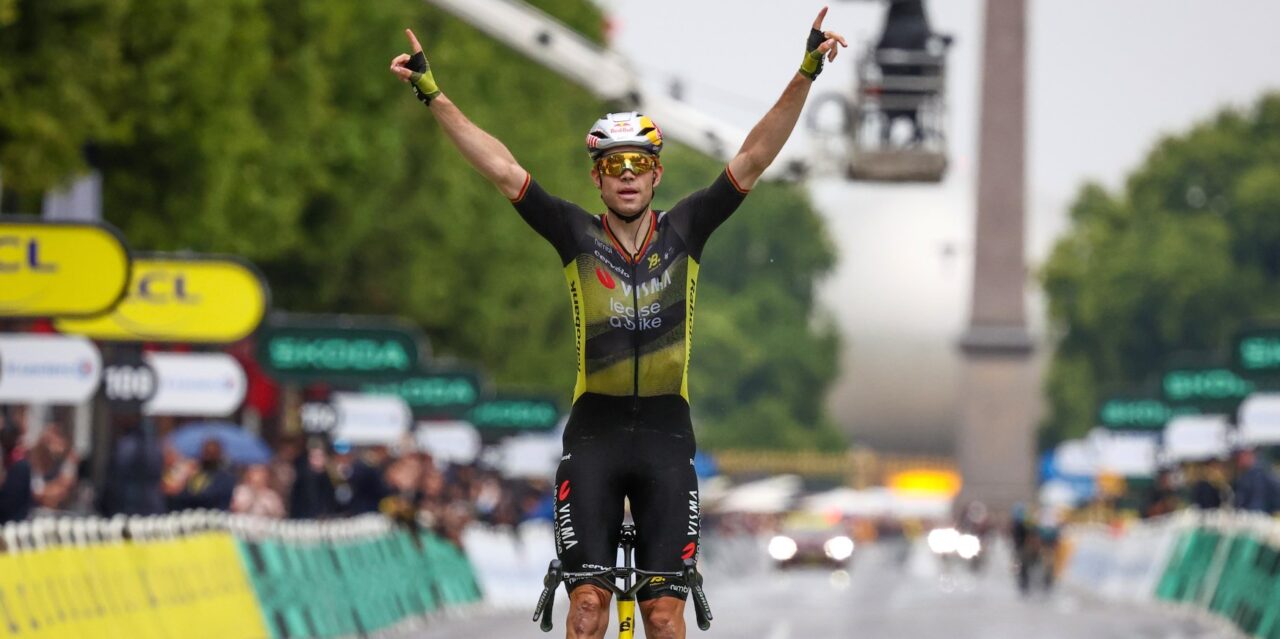
The way Wout van Aert broke away from yellow jersey Pogacar on Montmartre was masterful. The Belgian has had two difficult years in which meeting his expectations and confirming his palmarès seemed like a millstone around his neck. This dazzling demonstration dispelled his own frustrations as well as doubts from much of the outside world.
It was wonderful to see how he rode straight into the arms of his team manager Richard Plugge on the Champs-Élysées. The very man who openly criticized and loudly condemned the three laps around Montmartre, Plugge will now be able to thank Tour director Christian Prudhomme for ASO daring to integrate the Olympic climb into the final Tour stage.
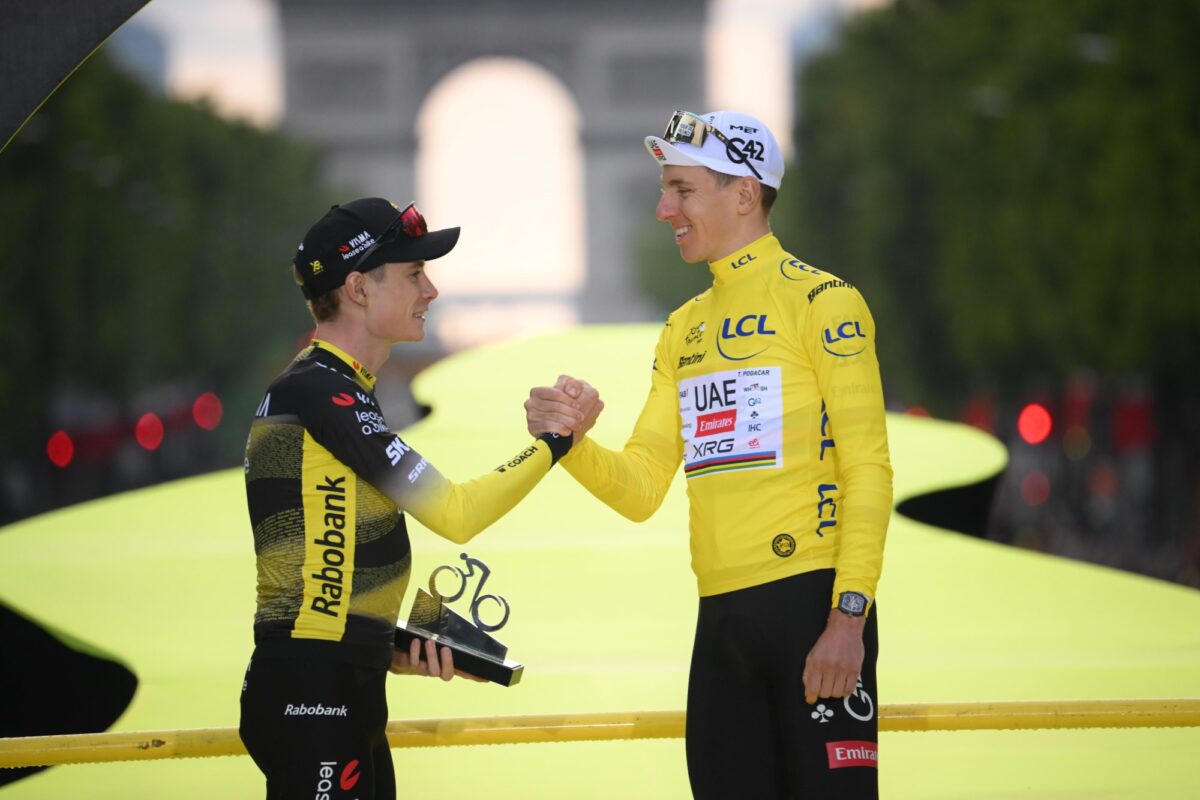
During this Tour, Plugge’s team, Visma | Lease a Bike, received considerable criticism. Undoubtedly, the Dutch yellow-black outfit was the strongest team in this Tour, but they are only as good as their team leader. Although their leader Jonas Vingegaard wasn’t up to Pogacar this year, the entire team supported him during the Tour. I do not mean this as criticism of Vingegaard. The Dane recorded better numbers during this Tour than in previous years, but he simply ran up against a superior Pogacar. A champion born once in a few decades.
Although this Tour was a one-man show by Pogacar, the cycling world owes Visma | Lease a Bike thanks for their racing style and refusal to give up the fight. Otherwise, it would have become boring very quickly. The Dutch team tried in almost every stage, although the team radiated far less synergy than in recent years. As a result, it sometimes seemed as if there was no plan behind their racing.
It all started at the Grand Départ in Lille, where an interview with Mrs. Trine Vingegaard in the Danish newspaper Politiken undermined the mood within the team. She criticized the team’s strategy, suggesting that other riders would be allowed to chase their own chances, which could come at the expense of supporting her husband in the mountains. This was a direct slap in the face for Van Aert.
Nevertheless, the team quickly closed ranks, but it could never stamp the race as dominantly as in the past five years. Several riders did not reach their usual level. Matteo Jorgenson was ill during the race and made some odd tactical choices. Sepp Kuss has not returned to his best form since his overall victory in the 2023 Vuelta a España. Simon Yates won the stage to Le Mont Dore beautifully but clearly still had the Giro d’Italia in his legs. And Van Aert searched for his best legs all the way to Paris.
In every way, it was clear in recent weeks that Visma | Lease a Bike struggled with the absence of several key figures. Not only did sporting director Merijn Zeeman leave the team. In the past two years, race captains Robert Gesink and Jos van Emden, nutritionists Asker Jeukendrup and Martijn Redegeld, coach Marc Lamberts, commercial director Sander Kruis, PR and press officer Ard Bierens, and several other staff members with rich histories at the team have also departed.
Zeeman’s departure weighs heavily. He was not only the man setting the sporting directions and the architect of ‘The Plan.’ Zeeman was also, like Gesink, Kruis, and Redegeld, a true bearer of the team’s culture. And precisely guarding the DNA with which the team has been chasing first place in the UCI team ranking since 2016 will become very important.
It is worrying to hear that more and more staff members say they have to introduce themselves every week to new people in the service course in Den Bosch. It is also noticeable that there is a regular preference for hires from Eastern Europe. Additionally, the new transfer policy, which mainly appears to look for cheap gems, raises questions.
The Italians Filippo Fiorelli (30 years, VF Group Bardiani), Pietro Mattio (21, Visma | Lease a Bike development team), and Davide Piganzoli (23, Team Polti VisitMalta), the Frenchman Bruno Armirail (31, Decathlon – AG2R La Mondiale), the German Anton Schiffer (25, Bike Aid), and the Belgian Timo Kielich (25, Alpecin – Deceuninck) are surprising acquisitions. But even in recruitment, it is extremely important to protect your DNA.
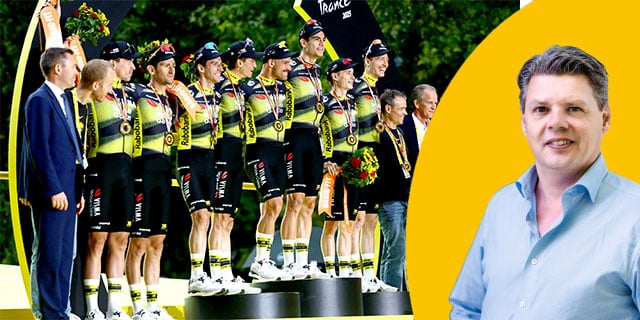
Everyone inside and around Visma | Lease a Bike will toast in Paris to yet another successful Tour de France. Rightly so, with two stage wins, the team classification, and second place on the overall podium, the team has once again delivered top performances. It is an unprecedented streak that the Dutch team has established in the grand tours over recent years. Still, these weeks in France also showed that it is important to thoroughly evaluate internally how and with whom they can continue this momentum within the organization.