Preview of the Vuelta 2025 Route: 11 Mountain Top Finishes and Return to Bola del Mundo and L'Angliru
The cycling races in August are speeding up. The Tour de France feels like it just ended, but the Vuelta a España is already approaching. Get ready for a classic Vuelta, with plenty of climbs, unexpected twists, and: a very exciting route. With this WielerFlits preview, you'll be fully up to speed.
For the first time in history, the Vuelta a España starts in Italy. Turin, the second largest city in Northern Italy, is the setting for the Gran Salida. This means that the Italian car city will have hosted the Tour de France, the Giro d’Italia, and the Vuelta a España within a little over a year and a half. In 2024, Turin was the finish location for stage three of the Tour de France.
The Vuelta stays in Italy for three days in 2025, after which it crosses over to France on day four. The riders stay in France only briefly, as on day five the Vuelta truly kicks off in Spain with a team time trial in Zaragoza. After this, the Vuelta becomes truly ‘the Vuelta’. That means: lots of uphill finishes and stages that are not necessarily very long. In total, this edition covers ‘only’ 3,138 kilometers, but boasts as many as eleven uphill finishes. You could wonder what the riders prefer: riding 400 extra kilometers and five fewer uphill finishes, or this...
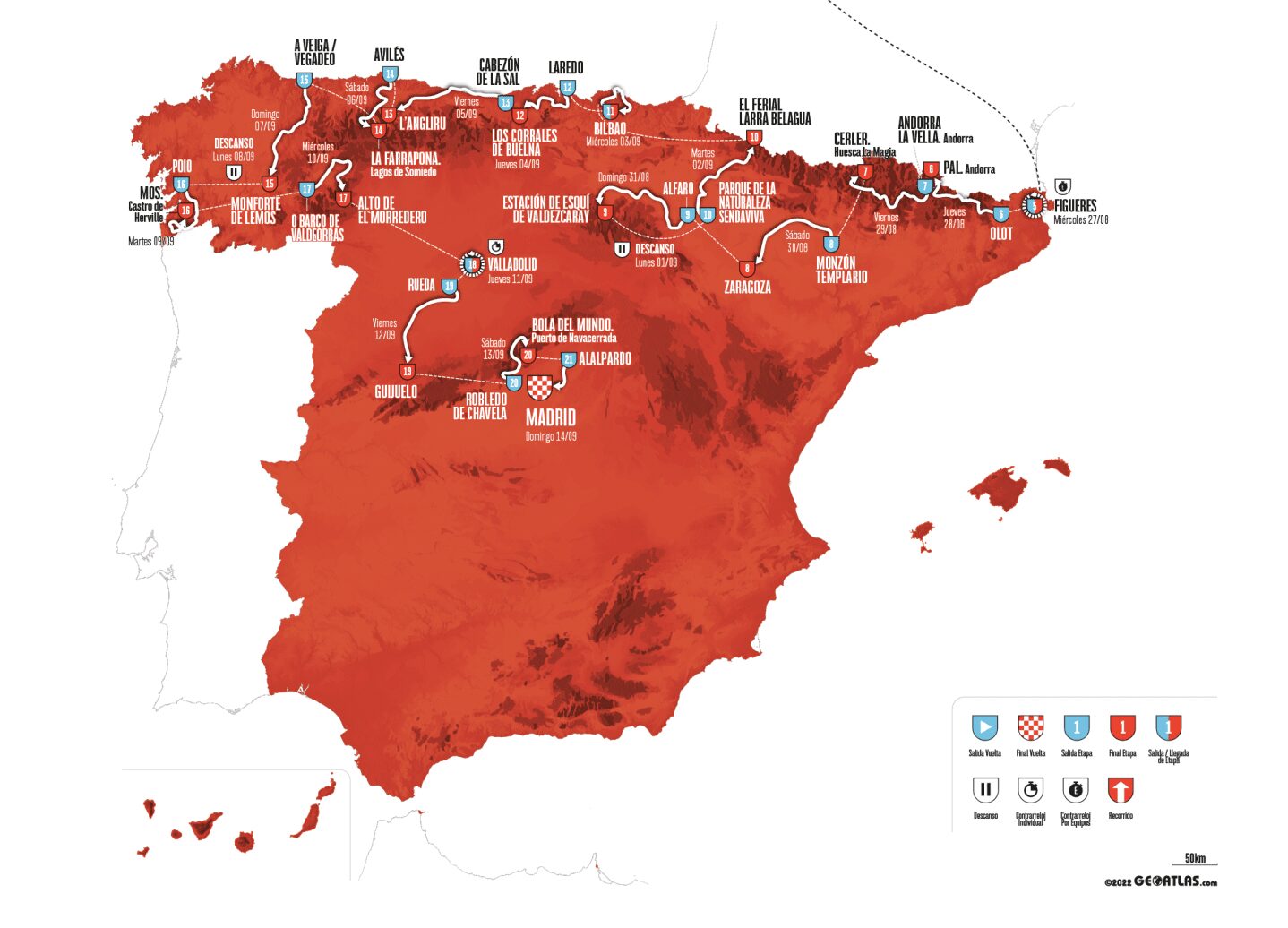
It promises to be another spectacular Vuelta, where the riders stay mostly in the northern part of the country. In the first week, the race flirts with the Pyrenees and Andorra, after which the peloton visits the Basque Country and the brutal climbs – the Alto de l'Angliru and La Farrapona – in Asturias during the second week. At the end of the second week, the riders arrive in Galicia.
After the last rest day on September 8, the riders reach the province of Pontevedra – still in Galicia on the Spanish west coast. From there, the peloton slowly begins to ride toward Madrid, with some significant transfers in the third week, including a move to Valladolid on Wednesday evening after stage seventeen. However, the Vuelta wouldn’t be the Vuelta if the organizers didn’t surprise us once more with a monster climb. That happens on the penultimate day, on the Bola del Mundo.
Vuelta a España in brief
21 stages
3,138 kilometers
Start in Turin
Three stages in Italy
Finish in Madrid
Rest days on Monday, September 1 and 8
2 time trials (1 team time trial, 1 individual time trial)
51 time trial kilometers
11 uphill finishes
Climbs including l'Angliru, Bola del Mundo and La Farrapona
5 to 6 sprint opportunities
Stage 1
The opening stage of the Vuelta is not super tough. Riders have to cover about 185 kilometers between the finish town Novara and Turin. The route designer managed to include 1,300 vertical meters, mainly due to the summit of La Serra (6.8 km at 5.1%) after around seventy kilometers.
After La Serra, the first Vuelta stage continues over gently rolling terrain. The final twenty kilometers are almost flat, so a bunch sprint seems almost guaranteed. The last time the Giro finished in Novara, Tim Merlier won ahead of Giacomo Nizzolo and Elia Viviani. So it looks like a sprinter will don the first red jersey in the Vuelta. Fortunately, the last 2.7 kilometers of the stage are as straight as they come.
Stage 2
The Vuelta wouldn't be the Vuelta without early climbing in the race. Even in Italy, the organization quickly finds a challenging climb to create the first time gaps in the general classification. It is the Monte Limone (7.6 kilometers at 5.4%), a second-category climb.
The peloton starts in Alba on Sunday and quickly heads toward the Alps. In the 159.6-kilometer stage, the first 150 kilometers are easy. The peloton rolls through villages like Saluzzo, Busca (where the intermediate sprint is located), Cuneo, and Borgo San Dalmazzo as it gradually approaches the base of Monte Limone. This climb is not that difficult but becomes much steeper near the top. Riders with a good punch could use this to break away. Monte Limone 1400 was also part of the 2002 Giro, when Stefano Garzelli won a sprint from four.
Stage 3
The third stage of the Vuelta takes the peloton from San Maurizio Canavese to Ceres. It's a short stage, with only 134.6 kilometers to cover. After the start in Canavese, a ‘sub-alpine’ village with just 10,000 inhabitants, riders face a relatively easy beginning. Some vertical meters are gained, but there are no climbs until about sixty kilometers in.
Then comes the Puerto Issaglio, a second-category climb that takes riders up to 849 meters high. The Puerto Issaglio (6.4 km at 6%) itself is not very difficult. After that, there is a constant up and down to the finish in Ceres. There's a short three-kilometer climb at nearly 5%, and also an uncategorized climb to Corio. The finale isn’t very tough; it’s mainly straightforward toward the finish in Ceres over rolling terrain. In Ceres, there’s a nice finishing gift: a final climb of 2.2 kilometers at 4.2%.
Stage 4
The fourth stage of the Vuelta goes from Susa in Italy to Voiron in France, covering a total of 206 kilometers. The first eighty kilometers of the stage are particularly tough as riders cross the Alps, but the final 120 kilometers are almost flat as the peloton heads to Voiron near Grenoble.
After the start in Susa, the road immediately begins climbing. The Puerto Exiles is the first obstacle of the day. Soon after comes the Col de Montgenevre (9 km at 5.6%), which features gradients over ten percent. The finale of the challenging opening phase starts in Briançon at the foot of the Col du Lautaret (9.2 km at 5.2%). Once at the top of this climb, riders reach nearly 2,100 meters altitude! After Lautaret, the stage is less exciting. The finale is almost flat, though the road climbs 2 to 3% over the last few kilometers.
Stage 5
After three days in Italy and a day in France, the Vuelta finally arrives in Spain (though not for the whole race, as Andorra is still to come). Figueres, a small city in Catalonia best known as Salvador Dalí’s birthplace, hosts the team time trial. In the past, quite a few Volta a Catalunya stages finished here, often ending in bunch sprints.
But a bunch sprint is definitely not expected on Wednesday. The team time trial covers 24 kilometers of fairly straightforward racing. The route includes just over 100 vertical meters, but those won’t decide the outcome. In the first twelve kilometers, teams head north, then in the last twelve kilometers, they head south back to Figueres. The last kilometer gently rises.
Stage 6
On Thursday, riders tackle a 170-kilometer stage through the rugged heart of the Pyrenees. The race goes from Olot to Pal in Andorra. From Olot, the riders immediately climb to leave Catalonia. It starts with the Collada de Sentigosa, an 11.3-kilometer climb at an average of 4.1%. Not a mega tough climb, but a perfect place for an early breakaway to escape.
After a fast descent to Ripoll comes the mega-long climb to Collada de Toses (24.8 km at 3.5% average). After a long descent, the riders enter Andorra, where two more climbs await: a second-category climb and the final first-category ascent. The Alto de la Comella (4.3 km at 7.5%) is the first, followed by the finishing climb to Pal (9.7 km at 6.4%). The climb isn’t the hardest of this Vuelta, but fatigue will be well built up after the day’s earlier hills.
Stage 7
The seventh Vuelta stage starts in Andorra La Vella and the peloton soon crosses back into Spain. Once in Spain, the climbs rapidly accumulate in this 188-kilometer stage to Cerler. The first climb comes quickly: the Port del Canto, a (again) hefty 25-kilometer climb averaging 4.3%. The climb is highly irregular, with kilometers above 8%, followed by almost flat stretches.
After the Port del Canto, the course calms down until halfway through the stage. At 102 kilometers, the Puerto de Creu de Perves awaits. Another long climb of 23 kilometers. After it, the Coll d’Espina follows, which is slightly longer than the guide suggests. The last kilometers of this climb are 5.9 kilometers at 6.5% average.
From 25 kilometers out, the road starts rising. First about 2%, then much steeper. The climb can be split into three parts, each separated by a short descent: first 3.2 km at 9.2%, then 2.7 km at 9.8%, and finally about 3 km at 7%. In total, that makes the climb to Cerler 12.1 km at 5.9%. As you can see, that’s a completely distorted picture.
Stage 8
The eighth Vuelta stage is 163 kilometers long, from Monzon Templario to Zaragoza. Although there are no mountain points to win along the route, riders still climb about 1,200 vertical meters. By Spanish standards, that’s flat: this is the last wrinkles of the Pyrenees. The stage itself is otherwise straightforward. The first eighty kilometers head west toward Huesca, followed by a descent into Zaragoza. The route initially loops around the city before the riders enter the beautiful old town.
The last four kilometers are almost straight, but nerves will build: at 400 meters to the line, there is a sharp right turn followed by the finish. The Vuelta last visited Zaragoza, Spain’s fourth largest city, two years ago, where the winner was... a sprinter. Juan Sebastian Molano beat Kaden Groves and Boy van Poppel there.
Stage 9
The ninth stage of the Vuelta takes riders from Alfaro (La Rioja) to the ski resort of Valdezcaray, also located in the Spanish province of La Rioja. For those who have never skied there: you might recognize this climb from earlier Vuelta history. A Vuelta stage finished here seven times before, though the last time was thirteen years ago, with the other six finishes in the late 1980s and early 1990s, featuring iconic winners like Fabio Parra (1991), Pedro Delgado (1989), and Sean Kelly (1988).
But before reaching the ski resort finish, the riders must complete a 195.5-kilometer stage. The ride is largely Spanish flat – or WielerFlits flat, if you will. Only at the top of Valdezcaray are mountain points available, but the total vertical meters are still significant: nearly 3,400 in total. The final climb, Valdezcaray (13.2 km at 5.2%), is not very difficult.
Rest day
Monday, September 1.
Stage 10
The tenth stage of the Vuelta is 175.3 kilometers long and starts in the afternoon from Sendaviva theme park, which is half amusement park and half zoo – and with its 120 hectares, one of the largest theme parks in Europe.
After the start, riders speed north. The first 120 kilometers are rolling but never truly tough. That changes with the Alto de las Coronas (7.2 km at 4.7%). After a short descent, riders begin a long approach to the final climb near the French border. Nine kilometers from the finish, the final ascent to the ski resort – again – Larra-Belagua (9.3 km at 6.3%) starts. The first kilometers are the steepest, then it eases off.
Stage 11
The eleventh stage starts and finishes in beautiful Bilbao. At 157 kilometers, it’s not very long, but promises to be very challenging. There are seven categorized climbs along the way! These climbs are typical for the Basque Country: not too long, not too high, but steep.
In the early phase, riders face the Alto de Laukiz and Alto de Sollube, but these won’t make a difference yet. Same goes for the Balcon de Bizkaia and Alto de Morga, both third-category climbs, all between four and five kilometers long with average gradients around 5 to 6%.
The finale really starts with the Alto del Vivero (4.3 km at 8.1%), which must be climbed twice. This is the climb where Marc Soler won in 2022. The difference with this stage? After Vivero, there is still another climb: the Alto de Pike (2.1 km at 9.4%), followed by 7.5 kilometers to the finish. We all remember the Alto de Pike from... the Yates masterclass in the 2023 Tour de France.
Stage 12
The twelfth stage looks nice on paper. It’s a stage where the first and second halves mirror each other closely. The route is flat, with a second-category climb after 35 kilometers and a first-category climb after 115 kilometers. Quick math shows the stage is 145 kilometers long, from Laredo to Los Corrales de Buelna.
At 35 kilometers, the Alto de Alisas (8.3 km at 6%) provides entertainment. Then about seventy kilometers of flat to rolling terrain lead to Collada de Brenes (6.6 km at 8.3%). The decision should come there, as there are just twenty kilometers descending to the finish. It again looks like a day for a breakaway to succeed – unless the GC favorites attack too early on the final climb.
Stage 13
The thirteenth stage brings the Beast of Asturias to the forefront: the Alto de l'Angliru. The stage starts early afternoon in Cabézon de la Sal, followed by a brutally tough 202-kilometer day with nearly 4,000 vertical meters. Like in this Vuelta, the approach to an important final climb is flat. Only after 150 kilometers does the road truly start rising, with the Alto de Mozqueta (6.6 km at 8.4%).
Then comes the tough Alto de Cordal (5.4 km at 9.3%). Although this climb is irregular and very tough, it seems like just a speed bump compared to what follows: the Alto de l'Angliru. The Angliru is one of the most brutal climbs in Vuelta history and has been featured many times before. The last time was in 2023 when Jumbo-Visma swept the podium with Primoz Roglic, Jonas Vingegaard, and Sepp Kuss. Should we mention the average gradient? Fine, the Alto de l'Angliru is 13.1 kilometers long and averages 9.5% gradient.
Stage 14
The fourteenth stage in the Vuelta closes out a brutal double in Asturias. This time, riders must tame not one but two Asturian beasts. The vertical meters again approach 4,000! It must also be said the riders will take about seventy fewer kilometers than the day before.
The stage starts in Avilés and heads to the summit of the Alto de la Farrapona (16.5 km at 6.2%). On paper, the climb doesn’t look very special, but the final 5.5 kilometers average 10%. This is a stage riders will surely fear. Especially as it is preceded by the Alto Tenebreo (5.7 km at 6.2%) and the Puerto de San Lorenzo (9.4 km at 8.8%).
Stage 15
After two incredibly tough mountain stages, the fifteenth stage seems like a break day before the rest day, but it’s far from easy. The 168-kilometer ride from Vegadeo to Monforte de Lemos features 3,300 vertical meters, although most climbing happens in the first sixty kilometers.
Immediately after the start, riders tackle the Puerto A Garganta (17.6 km at 4.9%), followed soon by the Alto de Barbeitos (11.8 km at 3.8%). After that summit, the route undulates for about fifty kilometers before flattening out again from Castroverde, apart from a ten-kilometer rise. In Monforte de Lemos, a strong sprinter or a breakaway rider is expected to win.
Rest day
Monday, September 7.
Stage 16
A new day, a new uphill finish in this Vuelta. It is already the ninth uphill finish in this edition. On Tuesday, riders cover 172 kilometers from Poio on the Spanish west coast to the Alto Castro de Herville (8.7 km at 5.1%) in the Galicia region.
It’s a stage that’s rarely flat. There are four categorized climbs, some tougher than others. The first, the Alto de San Antonino (9 km at 4%), appears only halfway through the stage, but before that there are multiple climbs. After San Antonino comes the Alto de Groba (11.5 km at 5.4%). Then the finale truly starts, kickstarted by the Alto de Prado (5.6 km at 6.2%), with the Alto Castro de Herville as the final act.
Stage 17
The tenth uphill finish arrives the following day in the race (and it’s not the last). Riders cover 137 kilometers from Valdeorras to the Alto de El Morredero. Unlike Tuesday, the approach to the final climb will be less tense. There is some up and down, but nothing serious. For the first time today, mountain points can be won on the Paso de las Traviesas (7.8 km at 4.2%).
After this climb, the finishing ascent appears – the stage isn’t very long. The final climb to the Alto de El Morredero (18.1 km at 6.3%) is first-category and features several very tough sections. Shortly after crossing a river, there is a 3.5-kilometer stretch at 10.3%, followed by a flatter section. Then comes a 4.3-kilometer section at 8.7%. In short: plenty of opportunities to create gaps.
Stage 18
The second time trial in the Vuelta takes place on the last Thursday. In Valladolid, riders face a nearly flat 26-kilometer time trial. The route is literally a copy-paste of the individual time trial in the Vuelta two years ago, when Filippo Ganna managed to beat Remco Evenepoel.
The time trial winds south through suburbs and the Real Valladolid football stadium, before returning via the Parquesol neighborhood to the city center. The first ten kilometers are technical, with many corners and a 700-meter climb, while the last twelve kilometers head straight to the finish. It’s a stage for true time trial specialists. Maybe Daan Hoole?
Stage 19
The sprinters also get their chance on the final weekend of the Vuelta. On Friday, riders cover 159 kilometers from Rueda to Guijuelo. There’s not much to say about the stage: no mountain points are available, the intermediate sprint comes after 103 kilometers in Salamanca.
The only danger is that the route isn’t completely flat. The entire day undulates between 729 and 1,012 meters elevation. The highest point is only at the finish, but will it force sprinters to drop? Hmmm, we don’t think so.
Stage 20
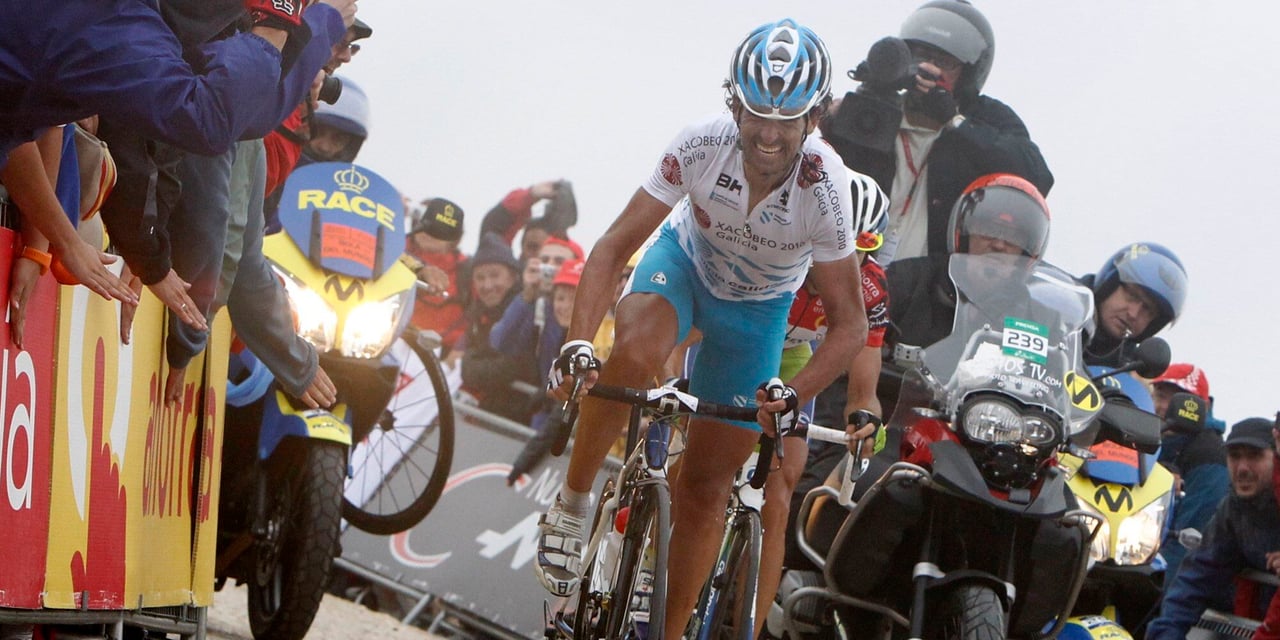
If you thought the Vuelta would gently wind down to Madrid after the time trial and sprint stage, you’re mistaken. On Saturday, perhaps the toughest stage in the race takes place as riders finish on the Bola del Mundo (12.5 km at 8.5%). This climb northwest of Madrid is legendary, also called the Rocket to the Moon in Tintin due to the antennas at the summit, but it appears in the Vuelta for only the third time. The last time was 2012.
Before Bola del Mundo, several brutal climbs in the Sierra de Guadarrama await: in order, Alto de la Escondida (11 km at 3.7%), Puerto de la Paradilla (5.5 km at 5.5%), and Alto del León (7.4 km at 7.1%) in the opening phase, and the Puerto de Navacerrada (6.9 km at 7.6%) in the penultimate part before Bola del Mundo. Fun fact: Puerto de Navacerrada later transitions into Bola del Mundo.
Stage 21
The final stage of the Vuelta ends, as so often, in Madrid. It will be a festive occasion with several laps through the beautiful old city center and the race covers 101 kilometers total. After the start in Alalpardo, riders have over two hours to take photos, ride calmly, and enjoy themselves.
The circuit used on this Sunday is 5.8 kilometers long and is introduced after 65 kilometers. Riders will then have plenty of time to reconnoiter the finale before the racing seriously begins and sprinting for the stage victory. For completeness: the loop runs via Paseo del Prado, Paseo de Recoletos, Calle de Alcalá, and Gran Via, finishing at Plaza de Cibeles.