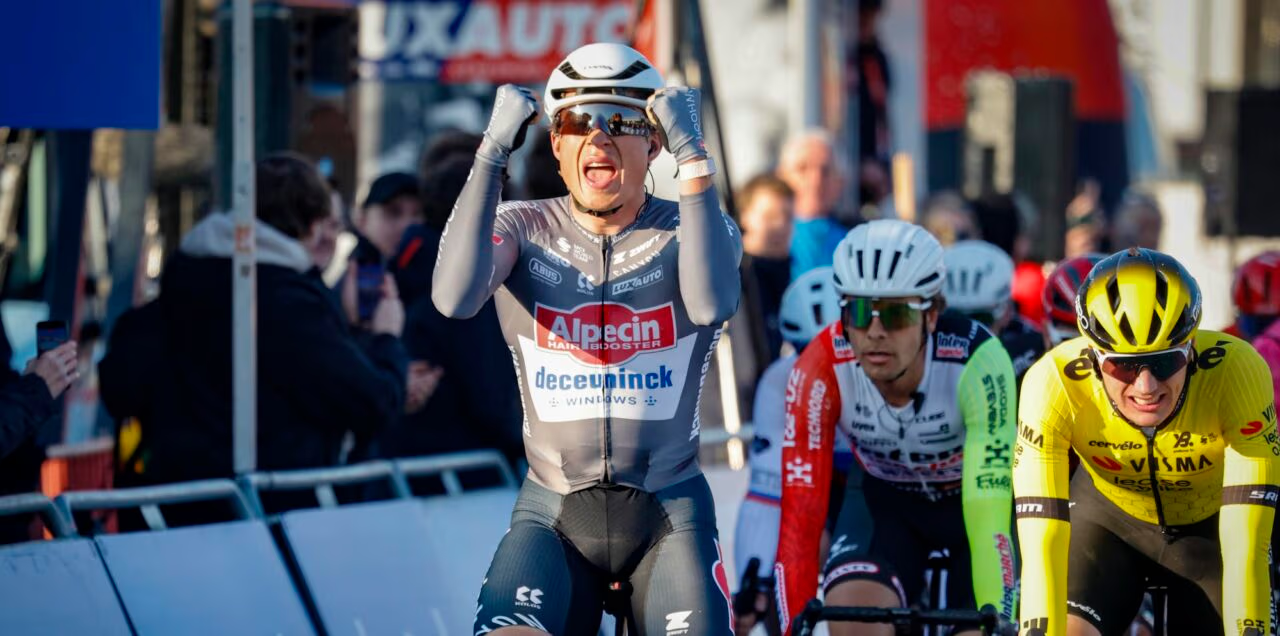
Preview: Kuurne-Brussels-Kuurne 2026 - Alpecin-Premier Tech holds the key
With or without Mathieu van der Poel, this Kuurne-Brussels-Kuurne could take a very different turn, but the crucial question remains the same in this second Flemish classic of the spring. Can the fast men survive, or will the difference mainly be made in the hill zone? WielerFlits looks ahead.
History
Last Edition
Route
Compared to previous years, there hasn’t been much change to the Kuurne-Brussels-Kuurne route, or rather Kortrijk-Brussels-Kuurne. The start is actually in Kortrijk, next to Kuurne.
In the opening phase of the race, one climb (Boembeek) has disappeared, but it has been replaced by a similar one (Lepelstraat). This has kept the race distance close to 200 kilometers. The wide finale looks exactly the same as last year.
It’s certain that the Hainaut trio we’ve seen for several years now—with Hameau des Papins (1,200 meters, average 6.6%, max 16.2%), Le Bourliquet (1,300 meters, avg. 6.8%, max 15.3%), and Mont Saint-Laurent (1,300 meters, avg. 7.8%, max 17%)—together with the final section featuring the Hotond, the Côte de Trieu or the Knokteberg, and the Kluisberg, can still turn the race upside down.
In total, there are thirteen climbs over the nearly 200-kilometer course. The first is the well-known Tiegemberg after just 16.7 kilometers of racing. After a transitional phase, the climbs—often cobbled—follow in quick succession after 65 kilometers. Think of stretches like Bossenaarstraat, Berg Ten Houte, and La Houppe.
The 500-meter-long Beerbosstraat, at 35.5 kilometers from the finish, is the last cobbled section and notable obstacle before the finish. Then, through the hilly Sint-Denijs, the race speeds towards Kuurne, where the finish line will be crossed after 181.5 kilometers.
What follows is a local circuit of 13.4 kilometers through Kuurne, Kortrijk, and Harelbeke. Here, the sprinters’ teams can still try to set things right, always guaranteeing exciting scenes.
Climbs
- Tiegemberg (1,400 m at 4%) – after 16.7 km
- Volkegemberg (1,000 m at 5.1%) – after 34.6 km
- Lepelstraat (2,100 m at 3.4%) – after 50.4 km
- Bossenaarstraat (1,300 m at 5.6%) – after 66.9 km
- Berg Ten Houte (1,100 m at 6.2%) – after 71.3 km
- La Houppe (1,880 m at 4.8%) – after 78.5 km
- Hameau des Papins (1,200 m at 6.6%) – after 96.2 km
- Le Bourliquet (1,300 m at 6.8%) – after 104.6 km
- Mont Saint Laurent (1,300 m at 7.8%) – after 109.7 km
- Kruisberg (1,400 m at 4.8%) – after 119.3 km
- Hotond (1,200 m at 3.1%) – after 120.9 km
- Côte de Trieu/Knokteberg (1,260 m at 7%) – after 127.9 km
- Kluisberg (1,100 m at 6%) – after 135.4 km
Favorites
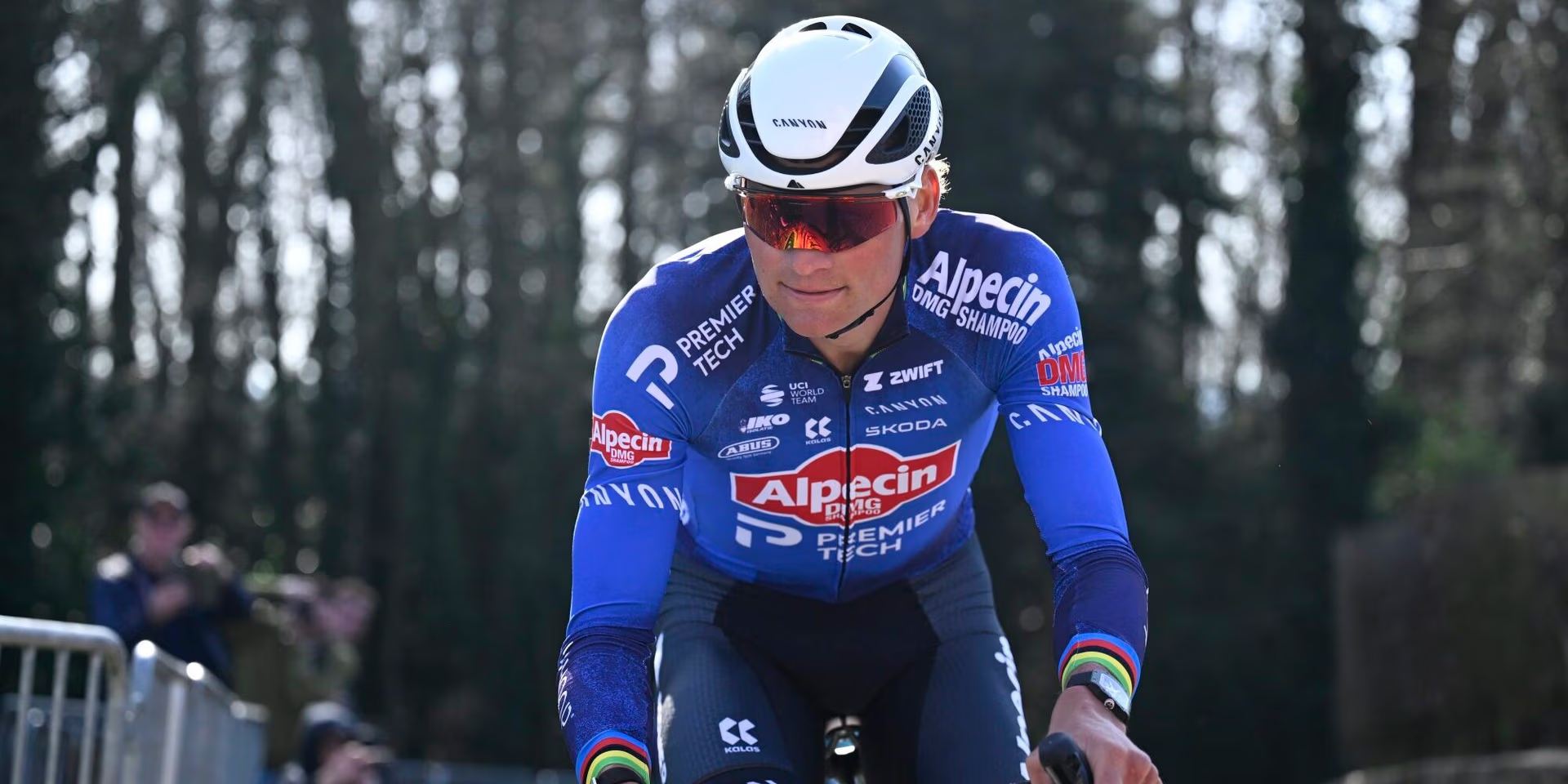
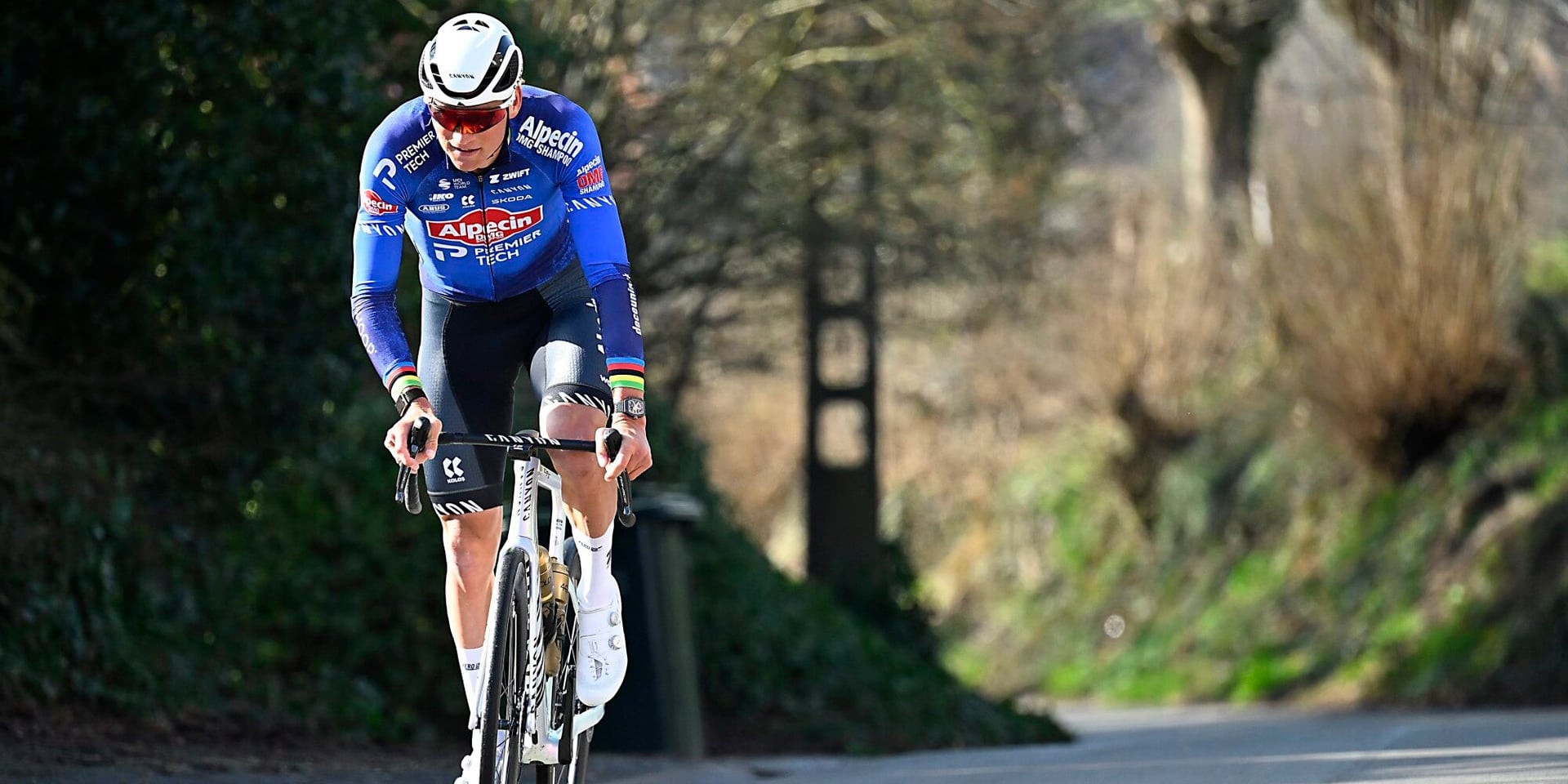
On Thursday afternoon, we had to completely rewrite this preview in a rush. Late that afternoon it became known that Mathieu van der Poel—although not on the provisional start list—is nevertheless considering adding Kuurne-Brussels-Kuurne to his program. The chance is even very high that the all-rounder from Alpecin-Premier Tech will start in Kuurne.
A Van der Poel participation obviously changes the entire race dynamics. You could see that the only previous time the ex-world champion came to Kuurne, in 2021. Back then, he blew the race open early and rode up front well into the finale with Jhonatan Narváez, but the race still ended in a sprint. Mads Pedersen won; Van der Poel finished twelfth.
This characterizes the hard-to-predict nature of Kuurne-Brussels-Kuurne. This has to do with the fact that the last tough climb is far from the finish line. There is always aggressive racing in the hill zone—and often a group breaks away there—but the question is whether that group can hold on all the way to the line in Kuurne. Last year, that was not the case, but in the two editions before that, the escapees succeeded. In other words, it can go either way again.
Decisive factors usually include the wind direction—it favors any breakaway if it blows at their backs over the last sixty kilometers—and the strength of the field. If big teams like Alpecin-Premier Tech, Soudal Quick-Step, and Visma | Lease a Bike don’t have a sprinter among them, the race tends to be quite open. This year they all have that fast man, but they also seem capable of aiming for different scenarios.
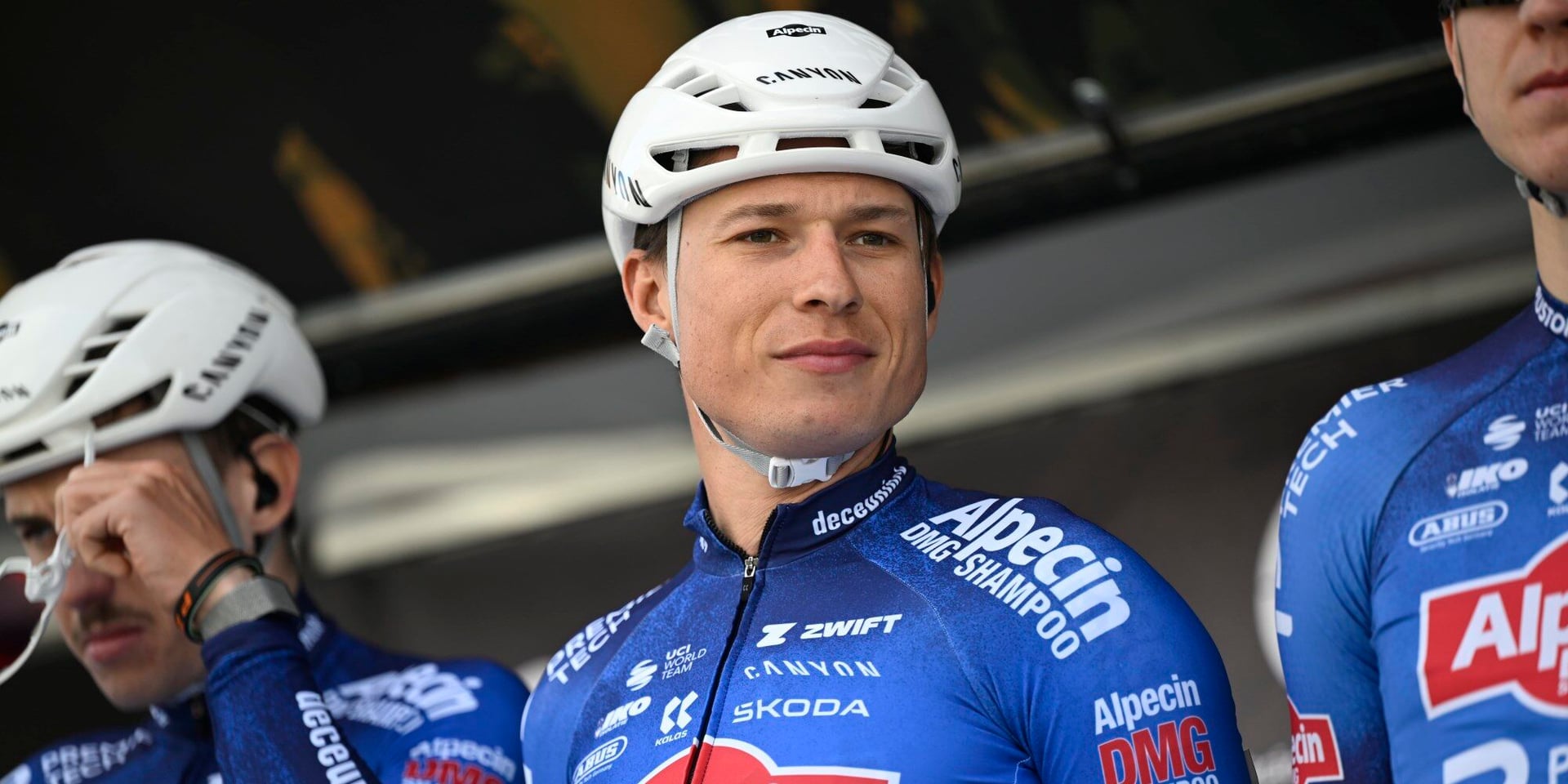
Besides Van der Poel, Jasper Philipsen will also start for Alpecin-Premier Tech. Philipsen, of course, is no stranger to attacking on the cobbles, but presumably the winner of last year will be somewhat held back alongside Van der Poel. The motto being: let Van der Poel go wild in the hill zone. If that doesn’t pay off, the Dutchman can still serve as the top lead-out for his Limburg colleague. Philipsen fears no one in the sprint.
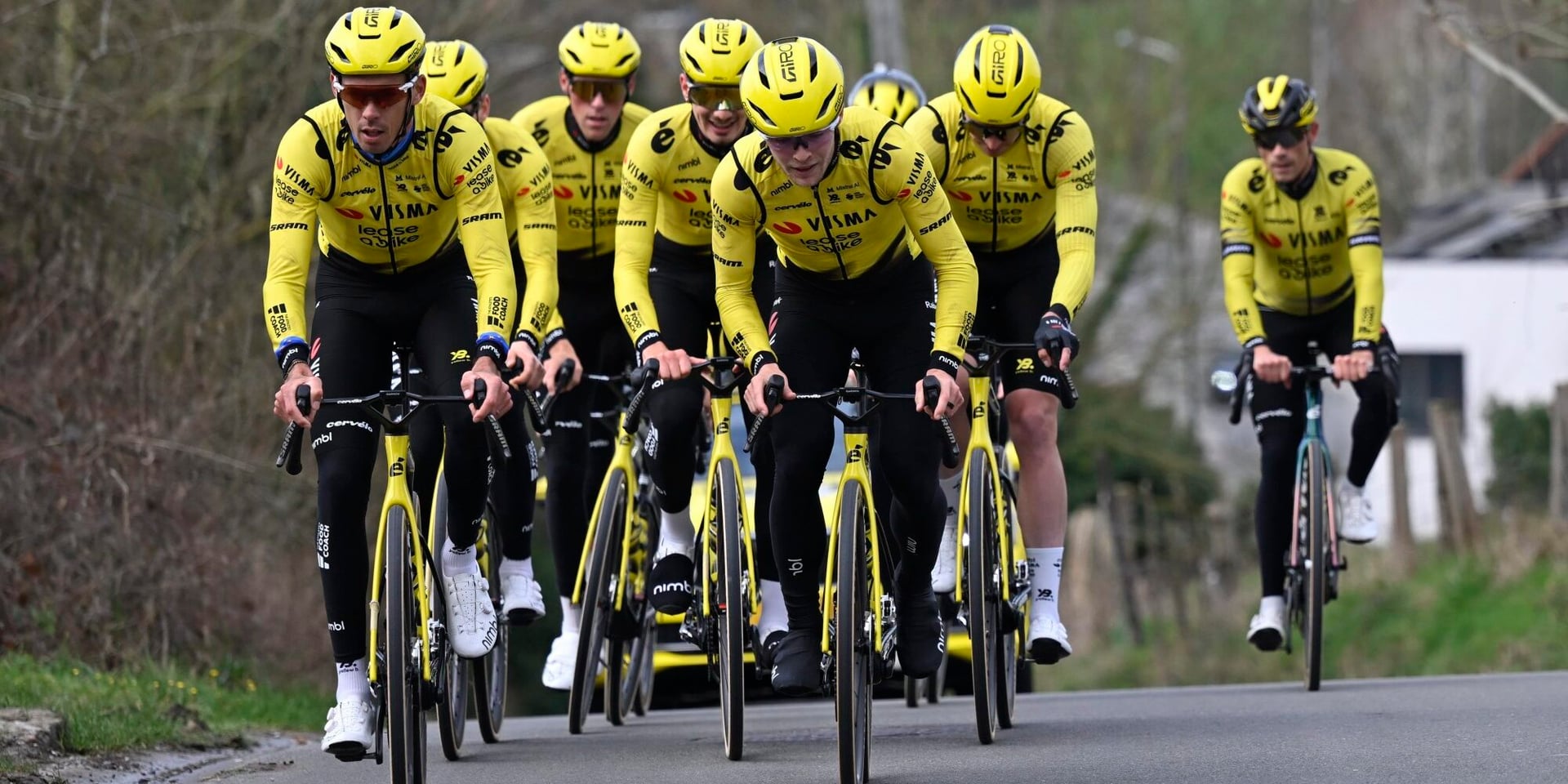
Although the chances for attackers seem to increase with Van der Poel’s presence, he will also have to bring enough support along. Within his own ranks, Kaden Groves, another fast man, seems most suited for this. Alpecin-Premier Tech therefore holds the key to the race. But we also see contenders on other big teams. Grischa Niermann has already told us that Visma | Lease a Bike, although Matthew Brennan is very quick, will not put everything on a sprint but race aggressively.
We will likely see Brennan joining the attacks on the climbs, although Christophe Laporte and Axel Zingle are arguably even better at this. The other top team, UAE Emirates XRG, will be happy with this. Riders like Tim Wellens and Florian Vermeersch have a sprinter in Juan Sebastian Molano, but not of Philipsen’s caliber. Teams like Uno-X Mobility and EF Education-EasyPost will also race offensively.
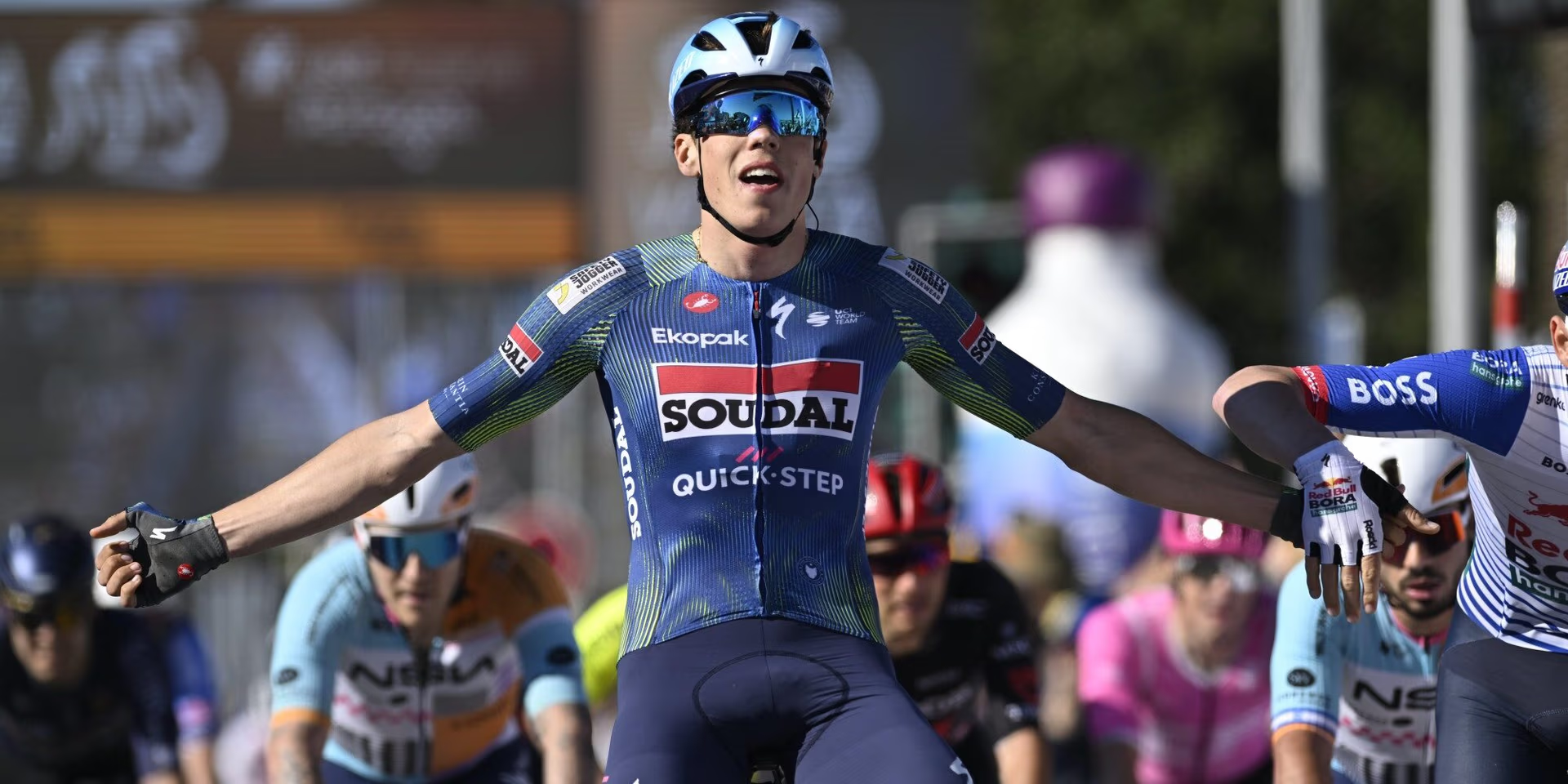
Other squads will be keeping a sideways eye on the sprint. At Soudal Quick-Step, they have a strong Dylan van Baarle in the hills, but they’ll primarily try to guide in-form rider Paul Magnier over the climbs. Lidl-Trek will do the same with Jonathan Milan, who is extra fresh at the start because he skipped Omloop Het Nieuwsblad. Both riders know what winning is after successes in the Algarve and UAE Tour respectively. Something to watch out for!
Other riders, such as Arnaud De Lie (Lotto-Intermarché) and Biniam Girmay (NSN Cycling), can sprint as well, but for them too, a hard race is preferred. Then the race will be decided more by freshness than speed. Expect them to be prominent upfront in the hill zone. The same goes for Matej Mohoric (Bahrain Victorious), Jordi Meeus (Red Bull-BORA-hansgrohe), Tobias Lund Andresen and Cees Bol (Decathlon AG2R), Milan Fretin (Cofidis), Mike Teunissen (XDS Astana), Rick Pluimers (Tudor), and Tom Crabbe (Flanders Baloise).
You also can’t underestimate the pure sprinters. At the last moment, Dylan Groenewegen will also make the start list for the Unibet Tietema Rockets. As a former winner, he knows what it takes to win in Kuurne. Phil Bauhaus (Bahrain Victorious), Pascal Ackermann (Jayco AlUla), Pavel Bittner (Picnic PostNL), and Paul Penhoët (Groupama-FDJ) are in similar situations.
Weather and TV
We won’t get classic Flandrien weather this weekend. The forecasts from Weeronline tell us it will be around twelve degrees Celsius this coming Sunday. The chance of rain is almost zero, which is good news for the riders. The wind will blow fairly strongly, around three to four Beaufort from the south.