Quality above all at Lezyne: "What we do here would be impossible in California"
Do you create something that primarily looks good or do you make something that functions as well as possible? At Lezyne, the emphasis is on the latter. They call it engineered design. RIDE Magazine saw firsthand how that philosophy is applied in the Taiwanese factories of the accessory brand.
If you’re not satisfied with the products available on the market, why not just make them yourself? That idea is the foundation of Lezyne. The American company was founded in 2007 by Micki Kozuschek. After successfully launching and selling bicycle brand Maxcycles and component brand Truvativ, Kozuschek noticed that the pumps and multitools he used did not meet his standards. There was plenty on offer, but, in his opinion, not good enough. So he decided to take matters into his own hands and focus Lezyne entirely on developing high-quality cycling accessories.
To do so, he moved to Taichung; the second-largest city in Taiwan and, above all, the heart of the international cycling industry. “Before Lezyne, Micki had several businesses, and their products were also manufactured here. He had so many contacts here that it made sense to bring Lezyne here too.” Those words come from Terry Cooke, who as Vice President of Engineering oversees all production processes at Lezyne’s Taiwanese factory.
“What we do here would be impossible in California. We would have to go to 5 to 10 different states to source all the various components and materials needed for our products. Here, everything is within reach. Because of that, Micki was able to develop his first product in four months, which otherwise probably would have taken a year and a half.”
Lezyne’s headquarters are located in Reno, Nevada, but the factory in Taichung is one of Lezyne’s most important assets. Everything can be made in-house there, and a large part of the production processes are self-managed. “We hardly outsource anything,” Terry explains. And if it’s not produced in-house, it’s still close by. “We source batteries and chips from abroad, but everything else comes from Taichung. That’s incredibly convenient because our engineers can visit our suppliers frequently. It gives us real insight into the products we get, their quality, and also how we can improve them.”
Lezyne has two locations for its various in-house processes. Starting with a factory hall where much CNC work is done. “That was something we long outsourced, but during the coronavirus crisis, we realized that was vulnerable. So we decided to do it ourselves. We started with four CNC machines, and now there are almost twenty,” Terry says. This CNC work mills housings for portable bike pumps and lighting, as well as the various bits for multitools. A major advantage because it keeps the production chain incredibly short.
“We almost always need several attempts to find the right design for a new product. Sometimes we need up to twenty prototypes to find the highest quality. The good thing about doing this ourselves is that we can go from design to physical prototype in just a few days. Of course, we can 3D print parts, but it’s very valuable that we can manufacture new products virtually directly from metal. Sometimes, we go from an idea to a product rolling off the line in only two months.”
Anodizing
However, there are also processes that Lezyne deliberately outsources. Anodizing, for example, a process where a hard, protective layer is applied to metal by running electricity through the metal in an acid bath. It’s a tricky and sometimes polluting task. “We could theoretically do this ourselves, but we prefer to outsource it so it’s done in an ecologically responsible way,” Terry explains.
Decisions are constantly made based on what’s best for product quality but also for the climate and environment. “Surface treatments are another example. We now use a process called bead blasting on as many of our products as possible (a method where small round blasting media is blasted under high pressure using compressed air, ed.), because it saves an enormous amount of water compared to traditional tumbling. And the little that really needs tumbling, we outsource. That’s better for the environment and also cost-effective.”
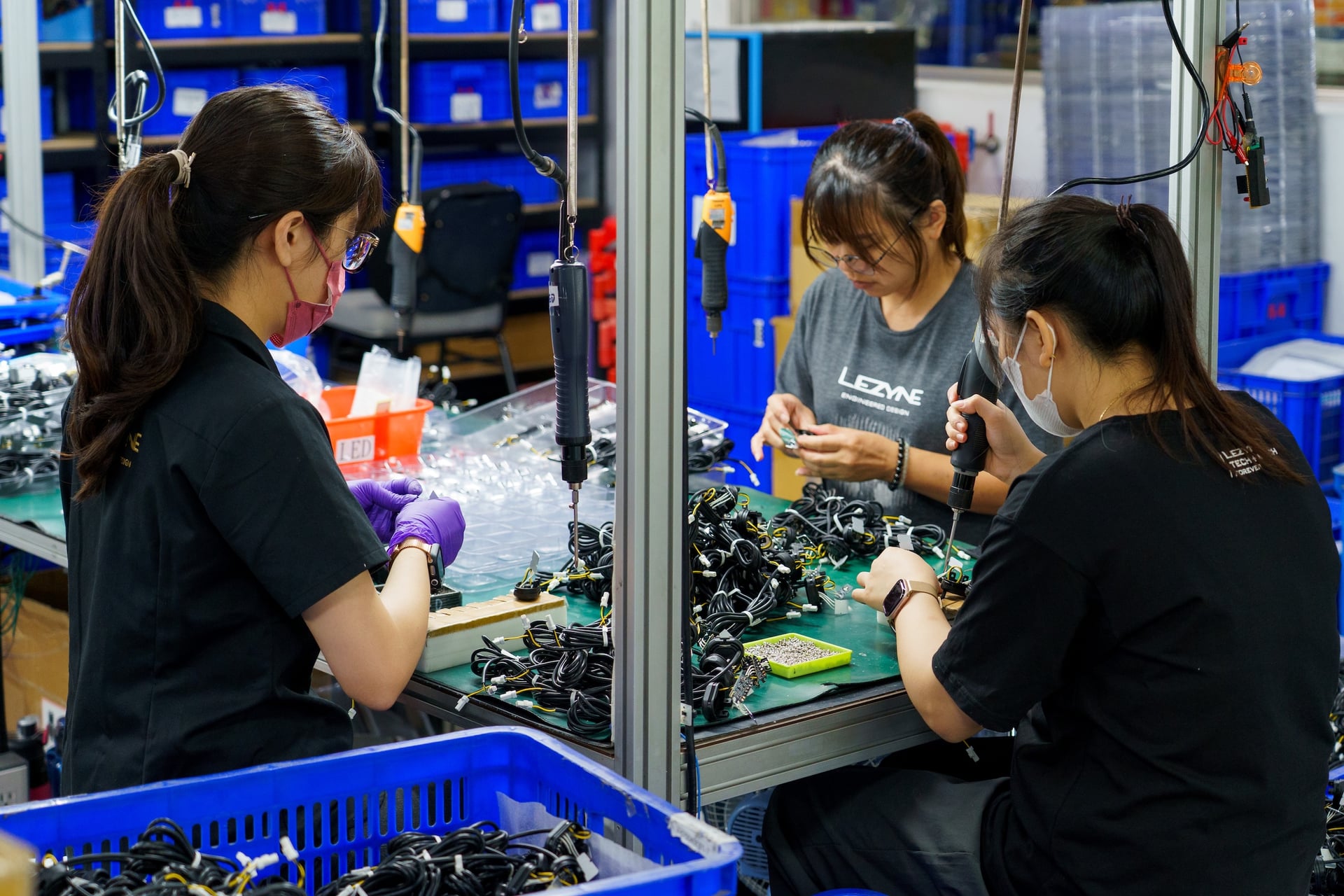
Besides the CNC factory, Lezyne has a second location in Taichung where the various parts are assembled into finished products. All the different components arrive there and are assembled by hand. From floor pumps to multitools and from bike lights to saddle bags. Dozens of racks filled with thousands of different parts stand there. It’s an impressive sight, but Terry speaks about it matter-of-factly. “We use all of this in about three weeks. We try to apply the Toyota principle as much as possible, where parts arrive two days before assembly. Those two days they remain idle, we use for quality control.”
And that last part is a magic word in this factory hall: ‘QC’, or Quality Control. It’s one of the things Terry is most proud of: the countless quality checks Lezyne performs on individual components and on finished products. “It starts even before they arrive at the factory. For example, we conduct checks on the parts we CNC ourselves. We check whether the dimensions are correct and if there are no deviations.”
Upon arrival at the factory, all parts are randomly inspected. Even parts they produced or developed themselves. “I simply don’t want us to deliver bad products. The user must be able to trust our products.”
At the same time, Terry adds that strict control is essential in Asia. “If you get parts from a manufacturer in Germany, you can be reasonably sure their technical reports are accurate. It’s different here. With companies we’ve worked with for a long time, we often know it’s good. But when starting a new partnership, it often starts great, but after three months, you get surprised.”
Thousands of vibrations
That’s why various tests are carried out on a large portion of the parts. Random checks are made on about one out of every 33 components. For example, some parts are inspected under a type of telescope to verify dimensional accuracy. Elsewhere, products are placed into a metal machine to test how they react to extremely high and low temperatures.
Additionally, there’s a machine that moves up and down for hours on end to test whether bike light mounts remain strong enough after thousands of vibrations. Almost everything is tested. Checks are also performed during and after assembly. Is the light waterproof? Is the beam bright enough? Does the pump head hold pressure? Nothing is left to chance.
That pays off, because over the years it has ensured Lezyne rarely receives returns due to defects. “At our CNC factory, we initially had batches that failed inspection and we couldn’t use. Now, we almost always catch that beforehand and can prevent it. That also saves costs. If we notice a part isn’t cut quite right, it saves us from applying further processing before it gets rejected. Our error margin at the CNC factory is only 0.5% on the monthly production of 200,000 parts. Thanks to all the quality checks, those parts never leave the factory for the user.”
That’s also what makes Terry so proud of their production in Taichung: the quality they have built up over the years. Lezyne either manufactures the parts themselves or sources them with ease from their proverbial neighbors. They set up assembly as they wish. Inspections can happen at any time. “The lines are so short in our company that we can influence everything. We truly have full control.”
Engineered Design
Lezyne’s slogan is Engineered Design. With this, the American company means that technical development comes first and is more important than the appearance of the products. “Our engineers are basically the product managers. They largely develop an idea. First, we come up with something and work it out technically; only afterward do we design it to also make it look good. That’s what we call engineered design, where we more or less reverse the design process. It’s form follows function: it’s easier to make something that works well than to make something that looks good also work well.”
Disclaimer: This article was written by an editor of RIDE Magazine. Lezyne is a media partner of WielerFlits and RIDE and supports our platform in this way.