
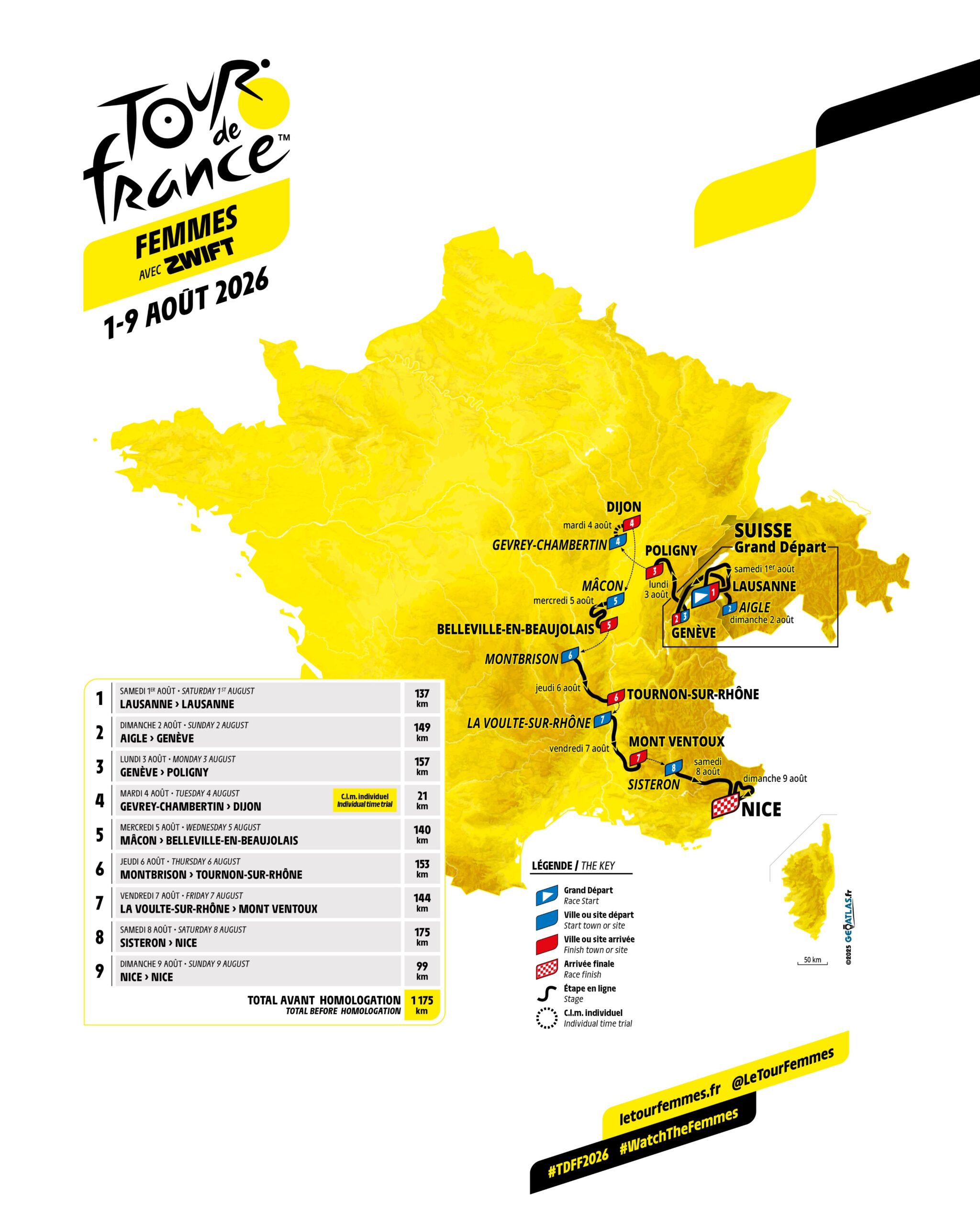
The Grand Départ of the Tour de France Femmes will take place in Switzerland next year. This was previously announced by organizer ASO, but what does the rest of the route actually look like? Now that the full route has been unveiled during the presentation in Paris, we know a lot more.
Swiss precision
The Tour de France Femmes starts next year on Saturday, August 1. The first stage, 137 kilometers long, starts and finishes in Lausanne. This stage suits puncheurs, as the finish comes after the Côte Saint-François (2.5 km at 4.6%). On day two, when the peloton races from Aigle to Geneva, the sprinters will have their chance. This 150-kilometer stage runs over relatively flat roads, especially in the finale.
[gallery link="file" columns="2" size="medium" ids="1241617,1241618"]
On day three, the caravan leaves Switzerland, as the race heads through the Jura towards France from Geneva. The finish is in Poligny. In the opening phase, there is significant climbing, including the Col de la Faucille (11.4 km at 4%), but in the final eighty kilometers, no noteworthy obstacles remain.
Time trialing is back
After this tricky stage comes the first crucial stage for the general classification. Next year, the riders will race again against the clock: the organizers have included a 21-kilometer time trial between Mâcon and Belleville-en-Beaujolais in the route. It’s a time trial with two faces. The first six and the last nine kilometers are flat, but halfway through, a climb leads up to the lake of Marsannay.
[gallery link="file" columns="2" size="medium" ids="1241619,1241620"]
Spectacle on the ‘Giant of Provence’
After this individual challenge on the time trial bike, there is a transition stage to Tournon-sur-Rhône with plenty of elevation, but the climbers will mainly be thinking about the stage on Friday, August 8. This is the most eye-catching stage, finishing on the slopes of the ‘Giant of Provence’. Of course, we mean the iconic Mont Ventoux (19.5 km at 7.9%) from Bédoin.
After La Planche des Belles Filles, Col du Tourmalet, Alpe d’Huez, and Col de la Madeleine in previous years, the Tour de France Femmes will again seek an iconic climb in 2026. However, after the Ventoux stage (with a massive 3,500 meters of elevation), the climbing excitement isn’t over, as the area around Nice could still bring new twists in the battle for overall victory.
Dazzling finale in Nice
The penultimate stage may not look too tough on paper, but the sting is definitely in the tail. In the last twenty kilometers, there are two climbs—the Côte de Colomars (1.4 km at 5.4%) and the Côte de la Ginestière (2.5 km at 5.4%)—on the way to the finish in Nice. The GC contenders will undoubtedly show themselves in this explosive finale but will likely save some energy for the short yet spectacular final stage.
In the ninth and final stage of 99 kilometers—also finishing in Nice—there’s even more climbing on the menu. Or should we say: one climb? The well-known Col d'Èze (7.7 km at 5.9%)—a long-standing decisive challenge in the Paris-Nice final stage—features no less than four times on the route. After the last passage of the Col d'Èze, it is just over ten kilometers to the finish.
[gallery link="file" columns="4" size="medium" ids="1241623,1241622,1241624,1241625"]

| Date | Stage | From | To |
|---|---|---|---|
| 01-08 | 1 |  Lausanne | Lausanne |
| 02-08 | 2 | Aigle | Genève |
| 03-08 | 3 | Genève |  Poligny |
| 04-08 | 4 | Gevrey-Chambertin | Dijon |
| 05-08 | 5 | Mâcon | Belleville-en-Beaujolais |
| 06-08 | 6 | Montbrison | Tournon-sur-Rhône |
| 07-08 | 7 | La Voulte-sur-Rhône | Mont Ventoux |
| 08-08 | 8 | Sisteron | Nice |
| 09-08 | 9 | Nice | Nice |