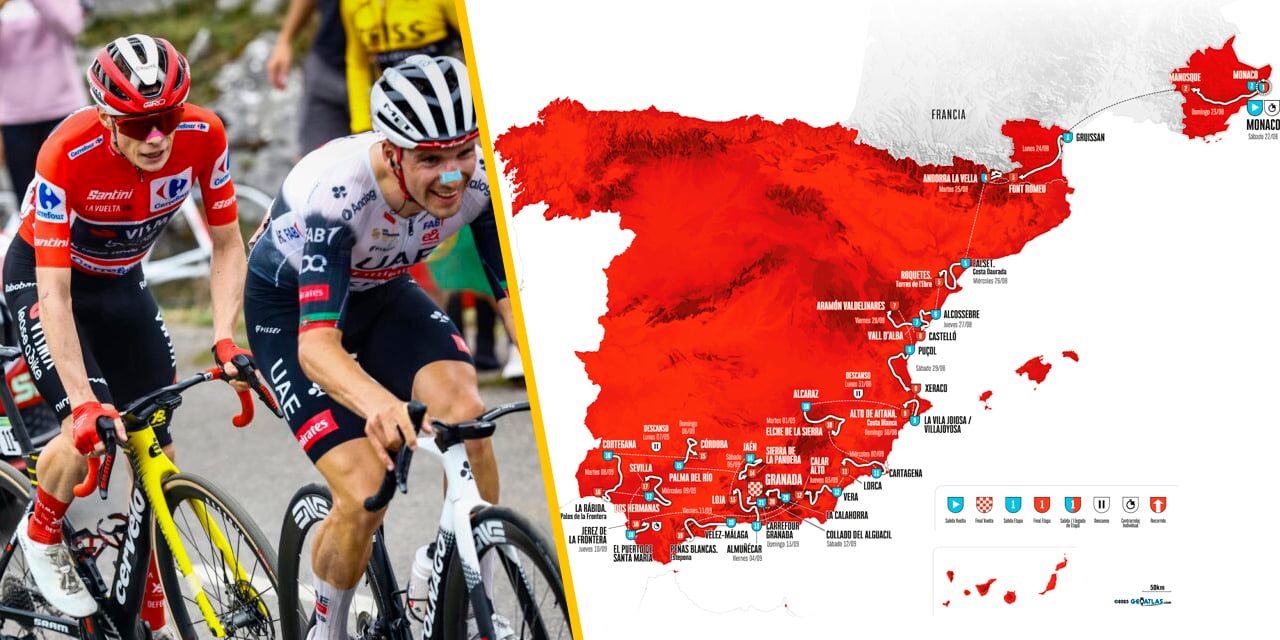
The route for the Vuelta a España has been announced. The organizers have chosen for 2026 to focus mainly on the south of Spain. There will also be an extremely tough finale in the Sierra Nevada, and the race ends with a remarkable, punchy final stage in Granada. Additionally, the Vuelta makes a detour to Andorra.
The Vuelta a España in 2026 will mainly take place in the south of the country. The race still starts in Monaco, after which it quickly moves down the Spanish east coast towards the south of the country. The last two weeks take place entirely in the south. The Andalusia region is the big winner: cities like Cordoba, Seville, and Granada are all visited, while the finale unfolds in the Sierra Nevada.

Starting in a principality
The 2026 Vuelta a España will begin on August 22 with an opening time trial in Monaco. Riders will start their individual chronos on the square in front of the famous Monaco casino, finishing on the Albert I boulevard. This is also where the Formula 1 Grand Prix finishes every year.
In a 9.6-kilometer circuit, all the sights of the wealthy microstate must be passed. Besides the start in front of the famous casino, the race passes through the renowned tunnel, rides along the famous harbor (Port Hercule), and circles the Stade Louis II football stadium.
After the Gran Salida, the peloton heads south towards the Pyrenees. On the second day, there is a stage featuring several climbs and a lengthy 215 kilometers to Manosque on the Côte d'Azur. This allows the peloton to cross the Spanish border by the third stage, where a tough uphill finish awaits in Font Romeu.
First to Andorra, then quickly to the south
In the remainder of the second week, there is a visit to Andorra La Vella. The fourth stage is extremely short at 104 kilometers, but features some brutal climbs such as the Port de Envalira at nearly 2500 meters elevation and the Coll d'Ordino.
After Andorra La Vella, the peloton speeds down to southern Spain. Via Catalonia, where a sprint may take place in Roquetes, the peloton quickly passes along the east coast to the Valencia region, where three hilly stages await. The last stage before the first rest day promises to be spectacular, as the peloton must climb the Alto de Aitana near Calpe. This climb leads to a military base perched a few hundred meters higher than the Port de Tudons.
In the second week of the Vuelta, the peloton, as the rumors have long suggested, heads to Andalusia. From the inland town of Alcaraz, the riders will eventually make their way to Córdoba on Sunday. In the intervening days, the riders tackle several tricky stages in the Sierra de los Filabres.
The twelfth stage ends atop the Calar Alto at 2153 meters above sea level. The fourteenth stage to the Sierra de la Pandera is also considered tough, with a climb reaching nearly 1800 meters altitude. However, this week is still a relative calm before the storm, as in the final week the riders will enter the Sierra Nevada.
The final week of the Vuelta promises to be brutal. In stages sixteen and seventeen, the GC contenders will still be able to keep their cards close to their chest, as there are stages to La Rábida and Sevilla where the sprinters will finally get their genuine 100-percent opportunities.
On the eighteenth day, the climax of La Vuelta 2026 begins. There is a 32-kilometer time trial scheduled between El Puerto de Santa Maria and Jerez de la Frontera. The time trial to the seaside resort on Spain’s southern coast is mostly flat but will cause significant time gaps among the GC riders due to its length.
Climax in the Sierra Nevada and Granada
Finally, two days in the Sierra Nevada follow that can completely shake up the GC. Stage nineteen features an extremely tough 205-kilometer ride to Peñas Blancas. Although the stage profile seems fairly mild, the climb to Peñas Blancas at just over 1200 meters is brutal, with steep gradients approaching ten percent.
The queen stage is scheduled for the penultimate day. In a 187-kilometer stage, three first-category climbs await, and the final climb to Collado del Alguacil is beyond category. This climb is 17 kilometers long with an average gradient of 6.9 percent. The final kilometers of Alguacil exceed 10 percent. In total, the queen stage includes more than 5000 meters of elevation gain.
For the final stage, the organizers – like the Tour de France – have not chosen a sprinters’ stage. The Vuelta ends with a spectacular stage to Granada featuring five climbs and a sharp finish around the Alhambra. This provides ASO with a worthy alternative to the traditional Madrid finale, which cannot take place this year because the Formula 1 race visits the Spanish capital on the same weekend.
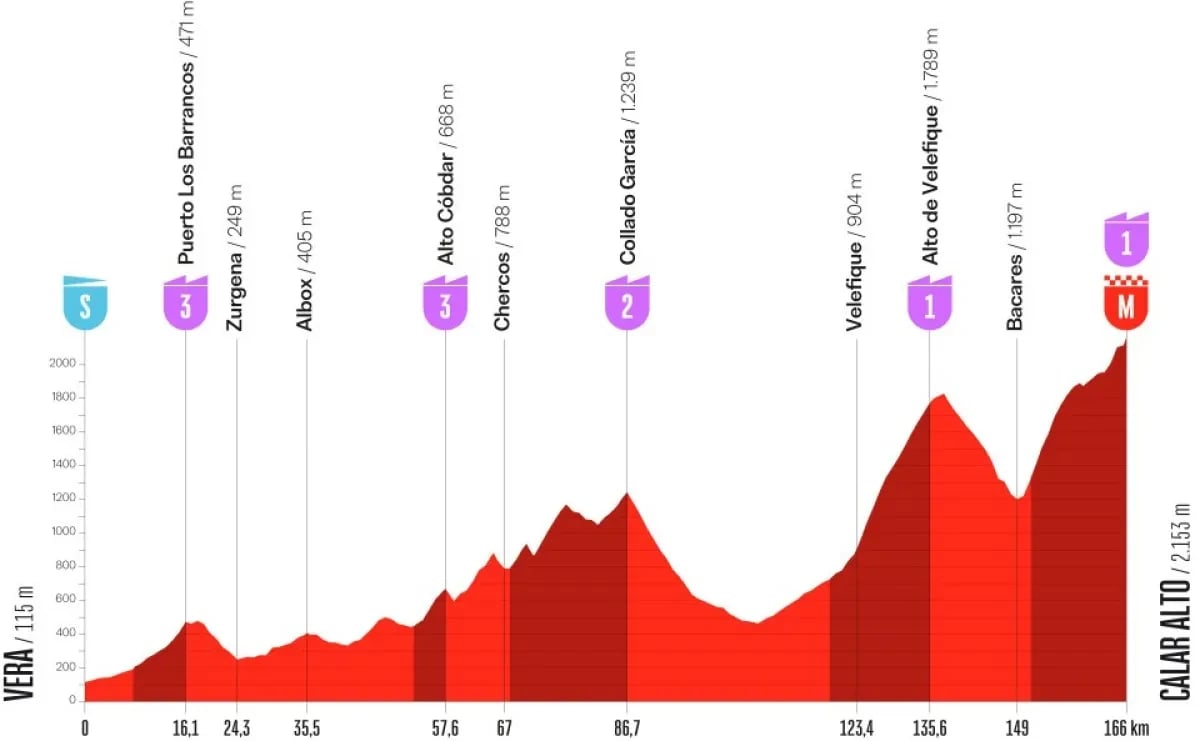
 Vera Observatorio Astronómico de Calar Alto
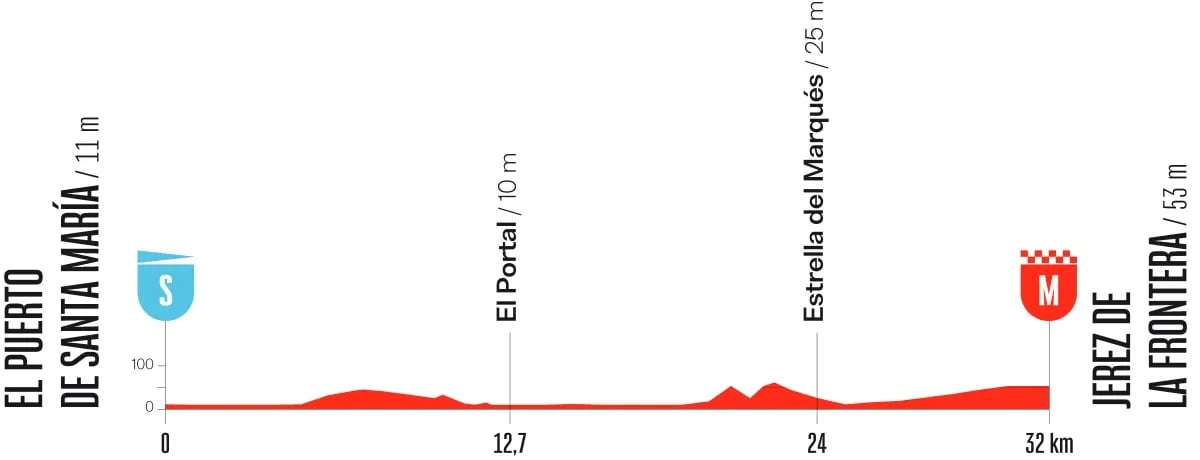 El Puerto de Santa Jerez de la Frontera
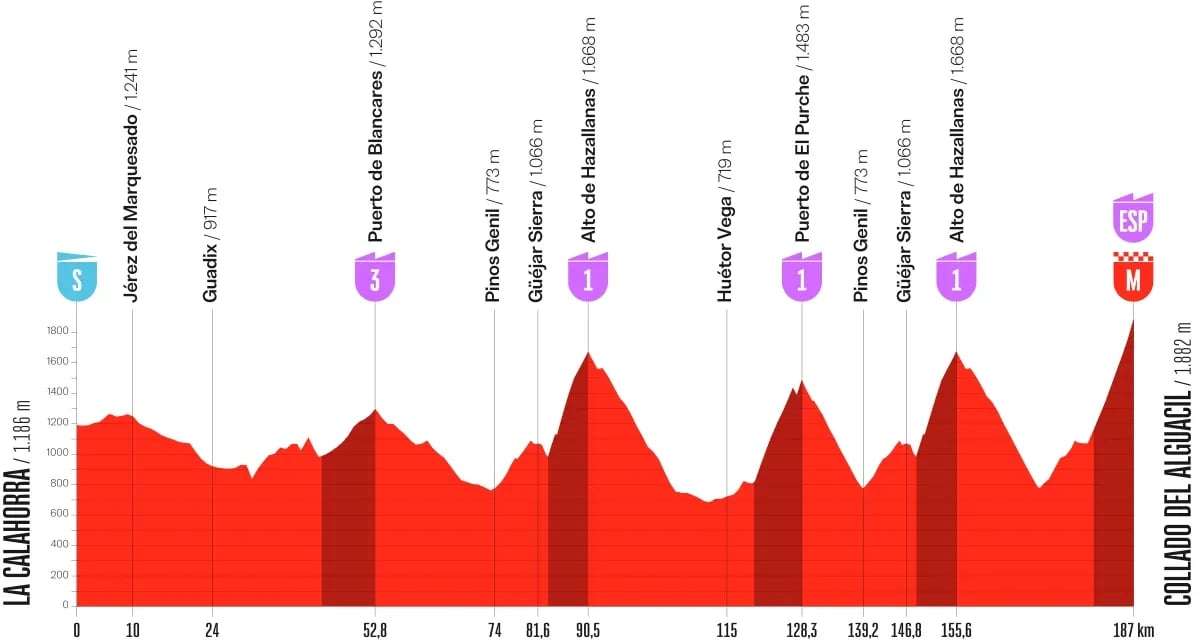 La Calahorra Collado del Alguacil