Jan-Willem van Schip doesn’t always feel welcome in cycling: "That hurts a lot"
A month and a half ago, Jan-Willem van Schip made global cycling news at the NIBC Tour of Holland. Not because of his striking handlebar, which has long been under scrutiny, but because of his seatpost. According to the UCI, it was not allowed, and so from Switzerland, they overruled the race jury in the Netherlands: Van Schip was disqualified. For the first time, he looks back on the incident with WielerFlits. Whether or not it receives the stamp of approval.
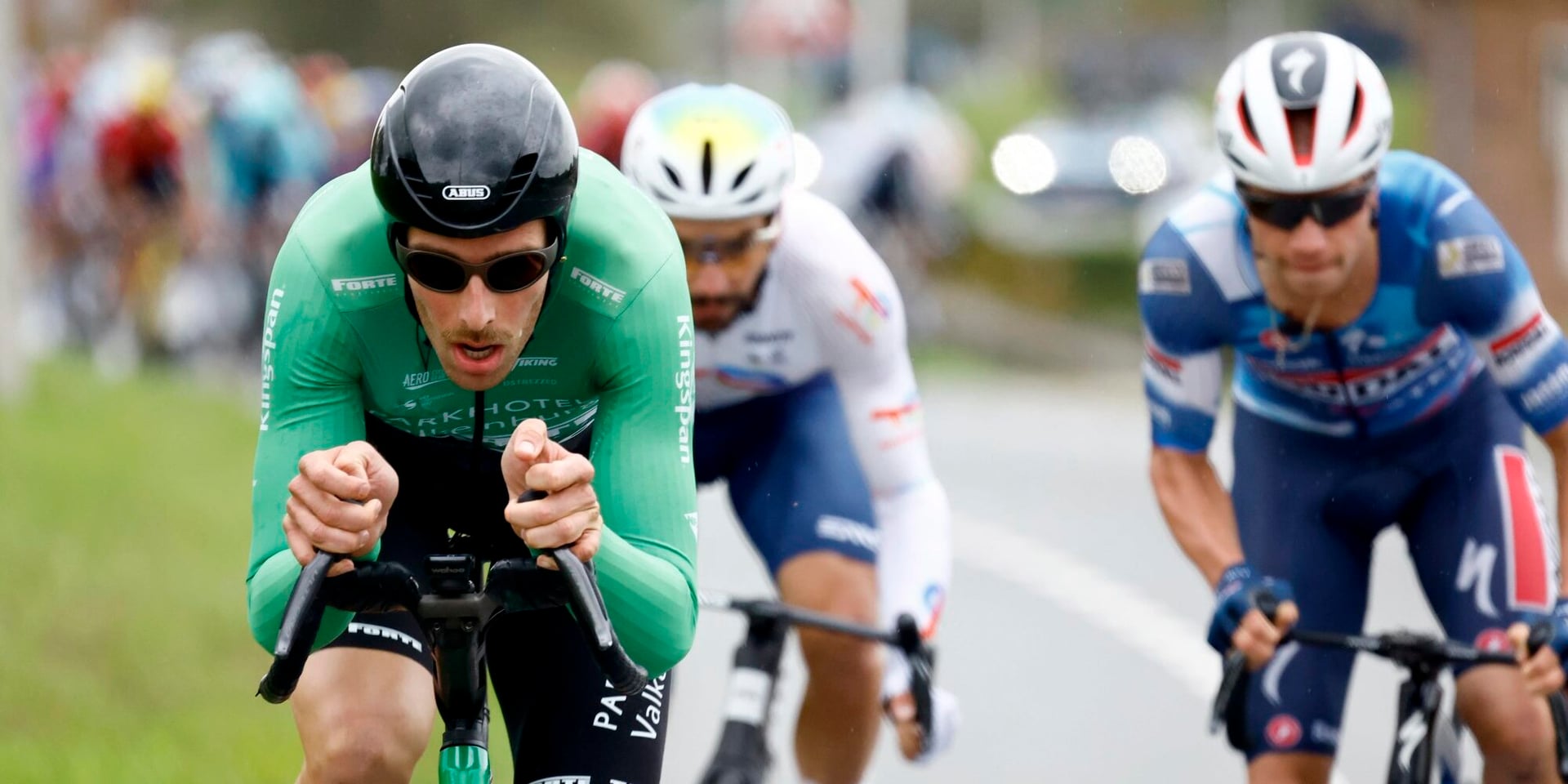
The 31-year-old from Wageningen rides over the finish line whistling in Dordrecht on his much-discussed bike with his distinctive sunglasses. Racing for the continental team Parkhotel Valkenburg, he tried to outsmart the pros in the finale of the circuit around Dordt. It didn’t work, as Tim Merlier sprinted to victory on the Stadsbrug Zwijndrecht. At that moment, Van Schip could not have foreseen the storm he would face a few hours later. Precisely because he was visible on screen thanks to his attacking style, several UCI officials in Switzerland took action. He had to be taken out.
From Aigle, they asked the race jury if they could take photos of Van Schip’s bike. These were then shared in the relevant group chat. The conclusion from the UCI was crystal clear: unauthorized seatpost, not compliant with the rules. Disqualification for Jan-Willem van Schip. The race jury of the NIBC Tour of Holland tried for fifteen minutes to contest the decision, but in Switzerland, they refused to budge. So the commissaires had to drive to Tilburg and deliver the bad news to the Dutchman at his team’s hotel.
To get right to the point: was that seatpost legal or not?
“It feels like a personal vendetta. I’ve been riding with exactly the same seatpost for two years – before that, it was a bent Giant seatpost, manufactured in the same way – and there was never an issue. But every time I do something, it’s put under a microscope. That’s just very frustrating. I’m not doing it for the attention. I’m definitely not trying to shake things up or do things differently. Absolutely not. I’m annoyed about this. But I want to explain it once and for all.
My handlebar from Tooth Engineering is legal. A 3D print of it has been tested and is ISO certified. The seatpost was cut apart and glued back together at a different angle. That’s it, nothing more. This was because our bike brand Tavelo has a seatpost was positioned too far back. I have flagged this at least ten times, but nothing was done. So I thought: I’ll just fix it myself. I never expected there to be a problem with it after two years. Ultimately, I’m the one in trouble because I solved it myself. I’m a tall rider, and my bike has geometry that doesn’t fit. That’s simply the problem here.
What stings is that if I had a bike where the saddle wasn’t positioned too far back, or if I weren’t 1.94 meters tall, or if I wasn’t Jan-Willem van Schip, or if I only rode at the back of the peloton, then there wouldn’t be an issue. The bottom line is simple: you have to ride on a seatpost that is approved, indeed. And mine is not. I have a problem, I fixed it myself, and yes, that’s not allowed. Of course, that sucks, but beforehand I never thought they would suddenly make a problem out of that seatpost after two years.”
What do you find most frustrating about this situation?
“I understand that people now think: Jan-Willem, it’s not allowed, you shouldn’t have done that. For me, it’s about how it happened and the consequences,” Van Schip continues. “I suffer from the commotion it has caused. Recently, I spoke to someone from Specialized. He told me that all tall riders on their bikes can’t ride with a saddle height over eighty centimeters. But some riders do need that. The chance that many more people are riding around with equipment that is just not quite UCI legal is 100%.
Again: I didn’t do it by the book and I should have pursued it more actively. But that didn’t succeed, even though I probably tried a hundred times. Is the disqualification then a fair penalty after I’ve been riding with it for two years? What could I have done as an individual and as a continental rider to get a seatpost approved? It’s also strange that with the same bike I finished third two weeks earlier in the Arno Wallaard Memorial. There were no issues in all those other races. But then you ride in view in the Tour of Holland, and suddenly there are all these problems. You feel so clearly that two standards are being applied.”
You were also removed from the results the day after the Heistse Pijl 2024 last year. Have you received any explanation from the UCI for that?
“No, and that’s the height of the absurdity. That was about the rule that you can no longer rest your forearms on the handlebars. At that time I was riding the same handlebar that I still use now. I haven’t changed my position. But this year, more riders have started doing what I was doing. Just look at Tadej Pogacar and Victor Campenaerts in the Tour de France. Then it suddenly isn’t a problem. Paul Tabak and I have asked the UCI ten times what the problem was because we just don’t understand. If they would just explain, but that hasn’t happened in a year and a half.”
You say you’re the only one executing it correctly? Playing devil’s advocate: how do you know your equipment choices make you faster or save energy?
“That’s no rocket science. Please go chat with ChatGPT for an hour. Look up what frontal surface area is, look up what the CD value is, see what happens when you put on a time trial helmet. For the Tokyo and Paris Olympics, I tested endlessly and gathered knowledge. When you look at that Excel sheet and you ride at a cadence of a hundred revolutions with a 55x14 gear, you produce 415 watts. But if you change to another handlebar and you ride 385 watts under the same conditions with the same variables: you simply can’t train to overcome that.
I’m also at university. The attitude there is: ‘oh, let’s listen to what someone pitches and thinks. Maybe they are right.’ But if you do that in cycling, you’re already ten-nil down. There’s nobody who says to me: ‘if you’ve been riding that kind of handlebar for five years, and with it you can even win offroad the Slag om Norg, you hardly ever crash, it goes well and you’re pretty successful… So what’s the deal?’. Instead, people assume it’s not possible. It’s always negative. That’s what I find the strangest.
Also you as a journalist. Go to a bike expo, buy a twenty-centimetre stem and the handlebar from Tooth Engineering. Just ride on it for a week. Nothing wrong! And suddenly you notice your back is relaxed because it matches your bike better. That’s my sore point. That openness and trust… I’m definitely not going to ride around for three or four years on a bike I can’t ride. While people come up to me as if I’m driving myself with a steamboat on a highway. It’s mainly the contrast that I struggle with a lot: what am I doing and what does cycling culture expect you to do?
If someone has great focus, or does descent training, gathers new input by talking to a sports psychologist, analyses race footage, or finds a new diet to have more energy, then in cycling we all say: ‘how cool, you did that really well!’. But if you purely look at the physics and ask yourself: what does a cyclist have to do to go faster? And you conclude that you have to ride with a twenty centimetre stem and want to try that. And then you ride through a peloton in a corner and everyone starts yelling at you. While that is equally part of the sport’s development. Then I ask myself: do others really do everything to win? Or is not falling out of line more important than trying to find the fastest way?”
What’s next?
“Tavelo will now arrange for me to have a good bike fit next year. I’ve started my master’s degree at university and I want to keep cycling for a few more years. I love it, cycling makes me happy and I’m good at it. I also enjoy going with Parkhotel Valkenburg to help the young guys solve their cycling puzzle. What’s possible, what’s allowed and how do we fix that? I see that purely as a calculation. We have to move forward as fast as possible at the right moment, how do we arrange that? Should I weigh my food or train to keep my shoulders together? Well, you have to do both. Both are needed to go faster.
That’s why this issue is so distracting, too. I’ve gotten caught in a political situation where everyone has an opinion. While I just want to win and go faster. I don’t want to be a political figurehead. If something from the past is still relevant – you have to clear the other guy’s plate first, for example – then I will delve into that as well.”
All things considered: do you feel the UCI has you in their sights?
“Yes, of course I feel that! That’s the entire problem, isn’t it?! If I’m in the Arno Wallaard Memorial in the breakaway with two Danes and we’re riding at fifty kilometres per hour through the polders, all three of us do the same. And then Willem van Schip rides in the Tour of Holland, and everyone gets all emotional about it. Look at the Arno Wallaard Memorial or any other race and everyone can choose how they sit on their bike. I’m just about the only one in pro cycling who does it well because of my physics background. That’s complex. And that’s frustrating because it’s my own responsibility.
In the end, no one benefits from this situation. But I have to solve it and make it right. And I don’t have time for that. The rules need to be much clearer. I need help with that because I just want to ride my bike. I simply don’t feel the UCI supports me in that. Or that they say: we’ll have a talk to warn you and work together on it. Absolutely not. I find that so unfair. I also increasingly feel that I’m not welcome, a kind of villain they don’t want. And that hurts a lot.”