UCI Shouldn't Immediately Turn the Gravel World Championships into a Cash Cow
The fourth edition of the Bolero Gravel World Championships once again demonstrated the tremendous potential of this event. After the first two editions in Italy and last year’s spectacular world title battle in Leuven, South Limburg has now shown that it is also a paradise for gravel riders. With Lorena Wiebes and Florian Vermeersch shining on the podium in the rainbow jerseys, the newest discipline in cycling was once again the big winner.
Credit where credit is due: Deputy Stephan Satijn of the Province of Limburg immediately recognized a great opportunity when Nice returned the organization of the Gravel World Championships to the UCI in April. He saw the possibilities this cycling discipline offers. After attempts to host the World Championships in the municipalities of Valkenburg and Venlo, Maastricht, Beek, and Beekdaelen ultimately joined this cycling adventure. It honestly couldn’t have gone better. Organizer Golazo deserves high praise for what has been achieved in Limburg in just a few months.
The stunning TV footage of the unpaved roads at the Gravel World Championships showed that South Limburg has much more to offer than just the well-known hilly landscapes of Valkenburg, Gulpen, Eijsden-Margraten, and Vaals. Especially now that the distribution of road cyclists and bike tourists in South Limburg has been a hot topic in recent years, this Gravel World Championships has opened ‘new’ routes for cycling tourism in the region.
By now, the World Championship route has been mapped out as a permanent course, allowing anyone to ride the gravel roads where Wiebes and Vermeersch triumphed throughout the year: wkgravel2025route.nl. Everyone realized this weekend that the Worlds offer even more possibilities. The Province of Limburg and organizer Golazo are now exploring whether a sportive ride can be organized (as was previously done successfully on the Worlds course in Leuven), or possibly even a brand-new race.
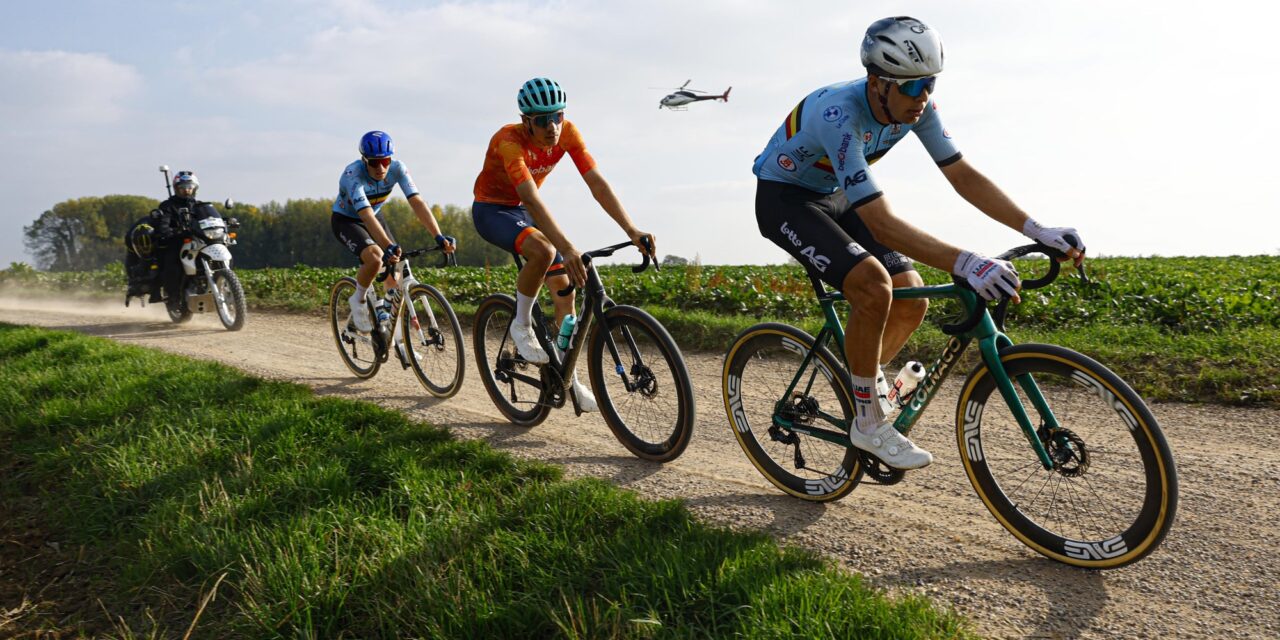 Florian Vermeersch for Frits Biesterbos and Floris Van Tricht. - photo: Fotoburo Cor Vos [/caption]
Whoever you asked about their experience—all agreed that the course mapped out by Bram Tankink was magnificent. Of course, it is not the coarse gravel like at Unbound or the Tour de France stages around Troyes. Experts call it ‘champagne gravel,’ where you can race at high speed. But precisely the combination of wide, long stretches with some steep, unpaved Limburg calf-burners, like the Stevensweg and Bronsdalweg, created a varied course. Thanks to those wide stretches, overtaking was easy everywhere and riders didn’t face the stress that singletracks usually cause.
In the men’s race, we saw how specialized gravel riders could compete with the road stars. Frits Biesterbos became the big Dutch hero with a second place behind the deserved world champion Florian Vermeersch. The former mountain biker also races on the road but now wants to focus on gravel racing.
Looking further into the top ten, you see that Floris van Tricht (4th) has specifically focused on this discipline. Felix Stehli (5th) is also a well-known name in the gravel scene, and Rick Ottema (8th) ended up in the top fifteen at the Worlds for the second year in a row. It was wonderful to see how they held their own, while road specialists like Matej Mohoric and Tom Pidcock were constantly riding at full power.
Another plus point of the Gravel Worlds is the participation in various age categories, attracting riders from all across Europe to Limburg. And how former pros like Johnny Hoogerland, Greg Van Avermaet, Jan Bakelants, and Niki Terpstra threw themselves fully into the fight.
The value of the Gravel World Championships has grown tremendously in just four years, while the sport’s popularity keeps increasing. It is unfortunate that next year’s Worlds are already in Nannup, Australia, likely limiting the number of international participants. It is utterly incomprehensible that in 2028 it will be held in Al-‘Ula, Saudi Arabia.
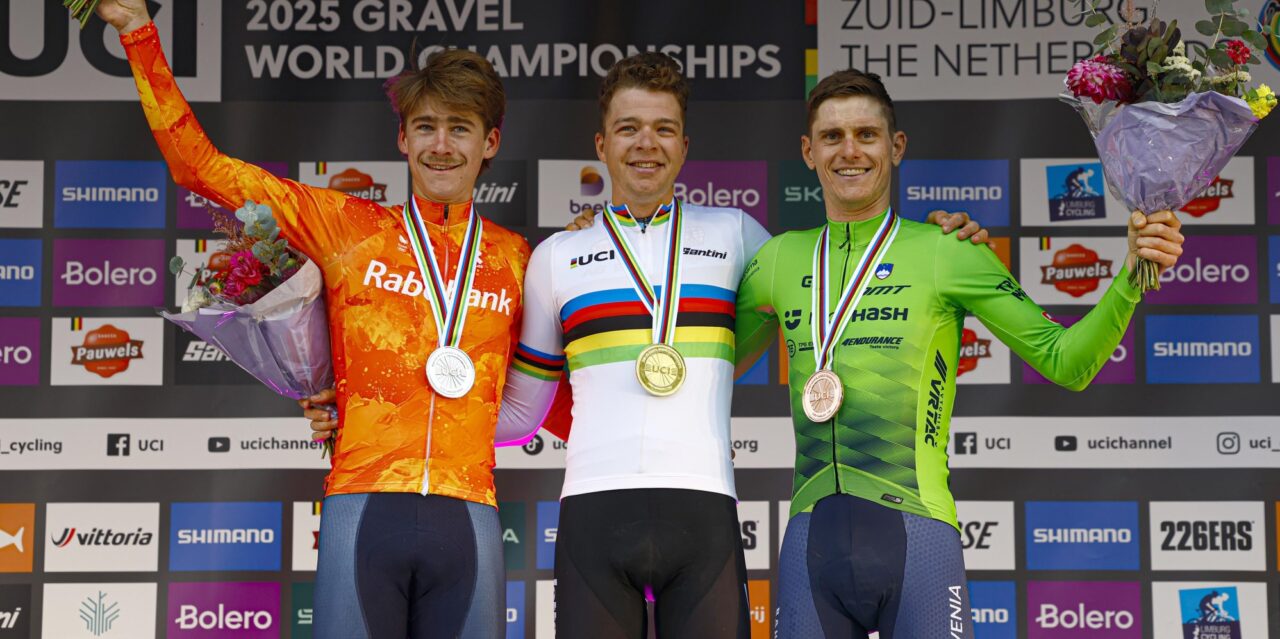 Frits Biesterbos, Florian Vermeersch, and Matej Mohoric. Photo: Fotoburo Cor Vos[/caption]
This shows that the UCI primarily chooses the host city based on the highest fee. The international cycling union could have developed the Gravel Worlds much better step by step in Europe (and possibly once in the United States) over the first ten years, allowing the event and the sport to develop organically. Unfortunately, the UCI mainly sees it as a cash cow for its own wallet.
The same goes for the UCI Gravel World Series. Instead of making it a series of classics, this format is now sold to as many cities and regions as possible. In 2025, the calendar features no less than 33 races, which has significantly diluted its value. If it had been limited to 10 to 15 races, most top riders would have started every event.
That gravel is hot was made clear once again last weekend. Hopefully, the UCI will also realize that it is much more than a hype.