Stage 16 Montpellier - Mont Ventoux (171.5km)
The Bald Mountain is always much less boring than its nickname suggests
The Tour caravan settles on the second rest day on the Mediterranean coast, in Montpellier to be precise. The sixteenth stage also departs from there the day after the rest day. The city center is always buzzing; street theater and musicians belong in the historic city center, partly thanks to the many students studying at the University of Montpellier, one of the oldest in Europe. It is also the birthplace of Rémi Gaillard. Videos of the famous comedian have been viewed hundreds of millions of times on YouTube.
The Tour likes to visit Montpellier. The coastal city has been a stage town 32 times already. The last time was in 2016, with a memorable finish. In the finale, the wind invited Peter Sagan and Maciej Bodnar to attack, answered by Geraint Thomas and yellow jersey wearer Chris Froome. Sagan won, Froome collected six seconds of time gain.
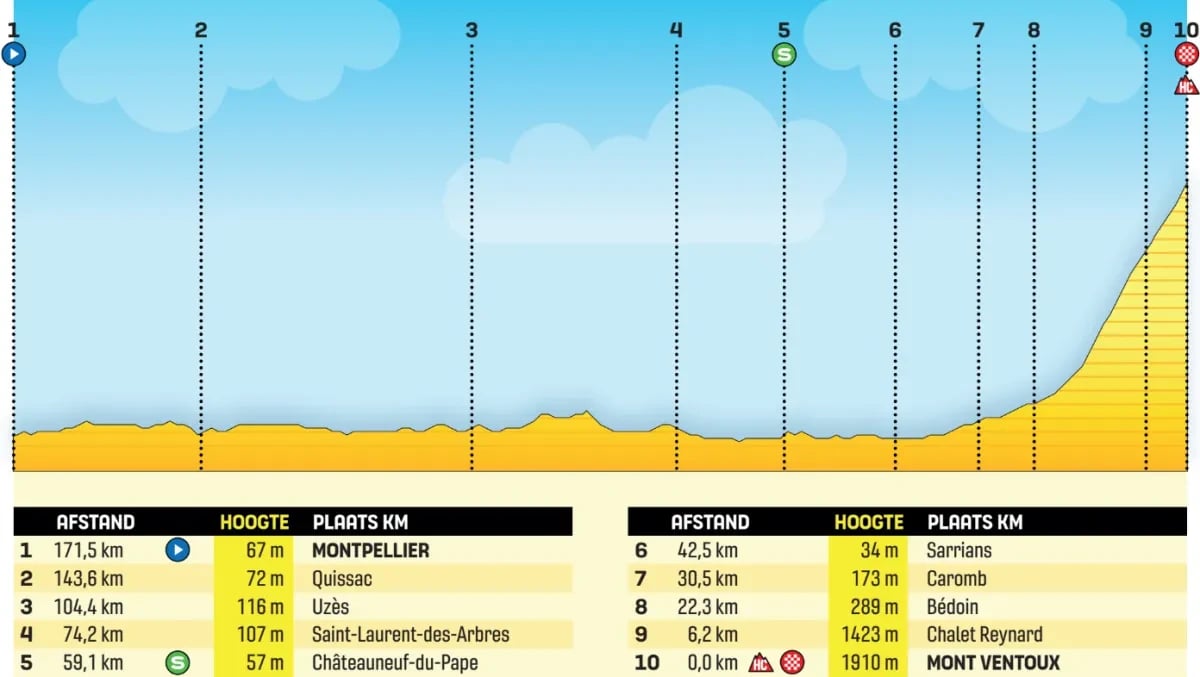
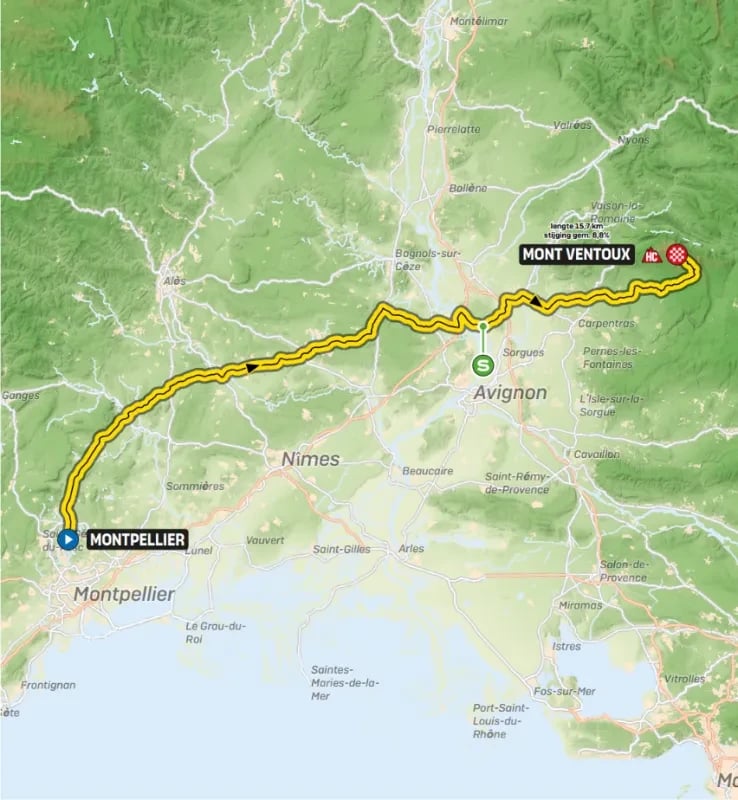
On paper, the sixteenth stage seems relatively simple: a long approach with a finish on Mont Ventoux. Yet in the name of that iconic climb also lurks the danger of this stage. In the adjacent region of Occitanie, vent is the word for wind. In addition, the name Ventoux is said to be dedicated to the Celtic wind god Vintour. From the start at the Mediterranean Sea, it's therefore important to watch out for echelons. The Tour organization sends the riders through the outer areas north of the cities of Montpellier, Nîmes, and Avignon. On the open roads there, the wind has free play.
Eventually, Mont Ventoux awaits, a mythical climb in the Tour. Yet it's 'only' the eleventh time in the rich Tour history that we finish at the top of The Bald Mountain or the Giant of Provence. Let's list the winners: Charly Gaul (1958), Raymond Poulidor (1965), Eddy Merckx (1970), Bernard Thévenet (1972), Jean-François Bernard (1987), Marco Pantani (2000), Richard Virenque (2002), Juan Manuel Garate (2009), Chris Froome (2013), and Thomas De Gendt (2016). Incidentally, due to strong winds in 2016, they didn't ride to the top, but the finish was at Chalet Reynard: the stage in which yellow jersey wearer Froome ran uphill in all the chaos.
Besides the ten previous summit finishes, the Ventoux has been included in the route seven more times. The last time was in 2021, when it was even included twice in one stage. Wout van Aert was the best escapee that day. Just like four years ago, they now ride up the mountain on the most difficult side. For the enthusiasts among us: that's the south side from Bedoin. This means that Mont Ventoux this year is 19.5 kilometers long with an average gradient of 7.9%. Especially the last section as you come out of the forest is extremely difficult. The riders then enter a sort of lunar landscape (which is why the Ventoux has the nickname Bald Mountain), with the wind once again being a determining factor.
| Date | Tuesday 22 July |
| Start |  Montpellier Montpellier |
| Finish | Mont Ventoux |
| Distance | 171.5 km |
| Elevation gain | 2950 m |
| Start time | 12:10 |
| Expected finish | 16:44-17:12 |


Stage 16 Montpellier - Mont Ventoux (171.5km)
The Bald Mountain is always much less boring than its nickname suggests
The Tour caravan settles on the second rest day on the Mediterranean coast, in Montpellier to be precise. The sixteenth stage also departs from there the day after the rest day. The city center is always buzzing; street theater and musicians belong in the historic city center, partly thanks to the many students studying at the University of Montpellier, one of the oldest in Europe. It is also the birthplace of Rémi Gaillard. Videos of the famous comedian have been viewed hundreds of millions of times on YouTube.
The Tour likes to visit Montpellier. The coastal city has been a stage town 32 times already. The last time was in 2016, with a memorable finish. In the finale, the wind invited Peter Sagan and Maciej Bodnar to attack, answered by Geraint Thomas and yellow jersey wearer Chris Froome. Sagan won, Froome collected six seconds of time gain.
On paper, the sixteenth stage seems relatively simple: a long approach with a finish on Mont Ventoux. Yet in the name of that iconic climb also lurks the danger of this stage. In the adjacent region of Occitanie, vent is the word for wind. In addition, the name Ventoux is said to be dedicated to the Celtic wind god Vintour. From the start at the Mediterranean Sea, it's therefore important to watch out for echelons. The Tour organization sends the riders through the outer areas north of the cities of Montpellier, Nîmes, and Avignon. On the open roads there, the wind has free play.
Eventually, Mont Ventoux awaits, a mythical climb in the Tour. Yet it's 'only' the eleventh time in the rich Tour history that we finish at the top of The Bald Mountain or the Giant of Provence. Let's list the winners: Charly Gaul (1958), Raymond Poulidor (1965), Eddy Merckx (1970), Bernard Thévenet (1972), Jean-François Bernard (1987), Marco Pantani (2000), Richard Virenque (2002), Juan Manuel Garate (2009), Chris Froome (2013), and Thomas De Gendt (2016). Incidentally, due to strong winds in 2016, they didn't ride to the top, but the finish was at Chalet Reynard: the stage in which yellow jersey wearer Froome ran uphill in all the chaos.
Besides the ten previous summit finishes, the Ventoux has been included in the route seven more times. The last time was in 2021, when it was even included twice in one stage. Wout van Aert was the best escapee that day. Just like four years ago, they now ride up the mountain on the most difficult side. For the enthusiasts among us: that's the south side from Bedoin. This means that Mont Ventoux this year is 19.5 kilometers long with an average gradient of 7.9%. Especially the last section as you come out of the forest is extremely difficult. The riders then enter a sort of lunar landscape (which is why the Ventoux has the nickname Bald Mountain), with the wind once again being a determining factor.