Stage 7 Saint-Malo - Mûr-de-Bretagne (197.0km)
Perhaps the most emotional memory of the Van der Poels
On Friday, the Tour de France returns to a place where one of the most iconic victories in the Tour of recent years was achieved four years ago: the Mûr-de-Bretagne, where Mathieu van der Poel, after a double attack, managed to win and did what his grandfather Raymond Poulidor never managed: taking the yellow jersey in the Tour de France. While the crowd favorite was also known as the Eternal Second - due to eight podium places in the final classification of the Tour, but never the final victory - Poulidor won seven stages in the Tour, Milan-San Remo, the Tour of Spain, and achieved three World Championship bronzes and one silver.
Enough about Poupou, there's more about him to read elsewhere in this magazine in a retrospective with the Van der Poel family on this memorable stage from 2021. This stage begins in Saint-Malo, a port city in Brittany. The old city wall is still present there. The area within it is called Intra-Muros or Ville Close, the enclosed city. The Germans had also entrenched themselves there during World War II. The Allies had the greatest difficulty taking Saint-Malo. A large part of the historic city was destroyed in the process.
Saint-Malo owes that city wall to - how could it be otherwise - the fortress builder Vauban. But there's more history. In 1491, Jacques Cartier was born in Saint-Malo. He later became a seafarer and explorer. Cartier discovered the land we now know as Canada. The Frenchman set foot on land at the settlement of Stadacona, not far from what is now Quebec.
On his second voyage, he sailed further up the Saint Lawrence River and arrived two hundred kilometers further at the next settlement, called Hochelaga. There, the indigenous population brought Cartier and his men up a hill, where they were kindly offered the vast view. The explorer baptized that hill Mont Royal. Later, that other famous cycling city in Canada was built around it: Montreal.
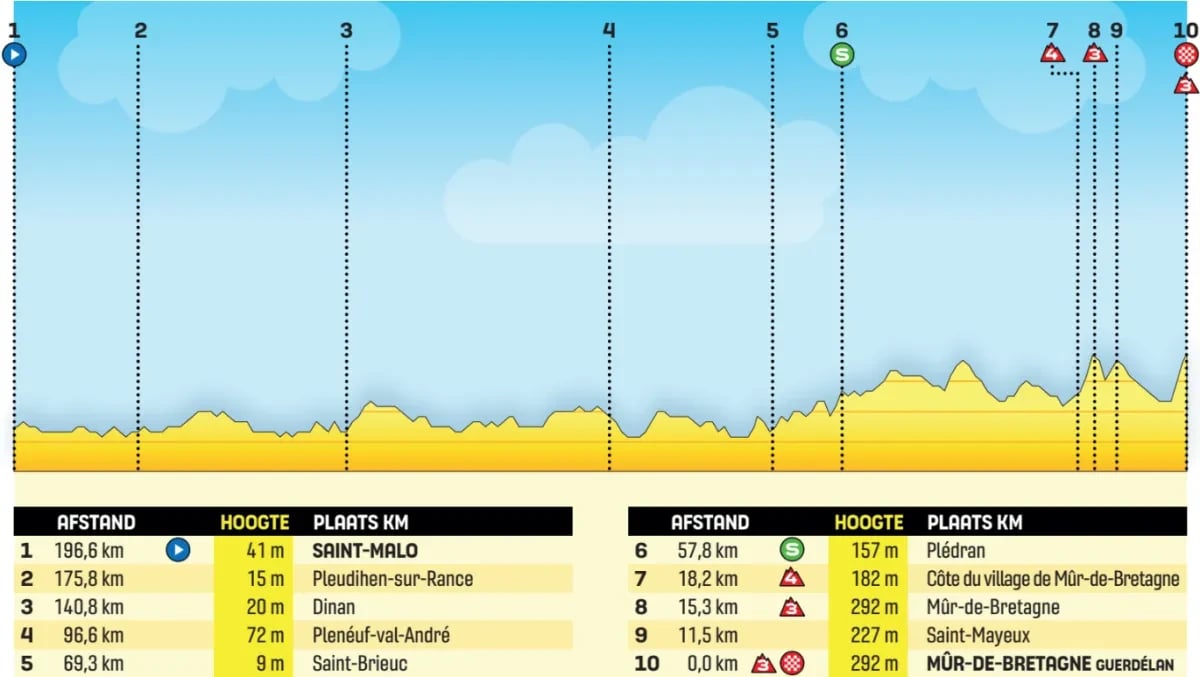
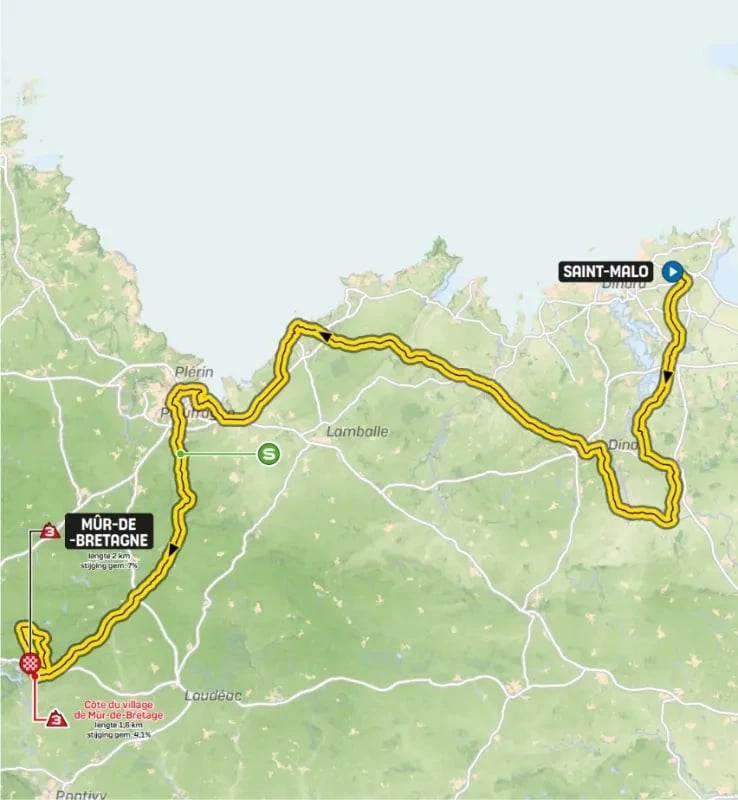
Back to the present, back to Saint-Malo. There, the seventh stage counts 194 kilometers and goes from Saint-Malo to the historic Mûr-de-Bretagne. From that point, a rolling ride awaits with the sting in the tail. On the final climb of the Wall with a length of 2 kilometers and an average gradient of 6.9%, the stage will probably be decided.
Notably, the Mûr-de-Bretagne is included twice in the finale, just like in 2021. The climb is first on the menu 17 kilometers from the finish, after which the peloton makes a short loop in the area. Two kilometers from the finish, the riders return to the foot of Mûr-de-Bretagne. There we will know the successor to Van der Poel, Dan Martin, Alexis Vuillermoz, and Cadel Evans, the previous four winners.
| Date | Friday 11 July |
| Start |  Saint-Malo Saint-Malo |
| Finish | Mûr-de-Bretagne |
| Distance | 197.0 km |
| Elevation gain | 2450 m |
| Start time | 12:10 |
| Expected finish | 16:39-17:04 |


Stage 7 Saint-Malo - Mûr-de-Bretagne (197.0km)
Perhaps the most emotional memory of the Van der Poels
On Friday, the Tour de France returns to a place where one of the most iconic victories in the Tour of recent years was achieved four years ago: the Mûr-de-Bretagne, where Mathieu van der Poel, after a double attack, managed to win and did what his grandfather Raymond Poulidor never managed: taking the yellow jersey in the Tour de France. While the crowd favorite was also known as the Eternal Second - due to eight podium places in the final classification of the Tour, but never the final victory - Poulidor won seven stages in the Tour, Milan-San Remo, the Tour of Spain, and achieved three World Championship bronzes and one silver.
Enough about Poupou, there's more about him to read elsewhere in this magazine in a retrospective with the Van der Poel family on this memorable stage from 2021. This stage begins in Saint-Malo, a port city in Brittany. The old city wall is still present there. The area within it is called Intra-Muros or Ville Close, the enclosed city. The Germans had also entrenched themselves there during World War II. The Allies had the greatest difficulty taking Saint-Malo. A large part of the historic city was destroyed in the process.
Saint-Malo owes that city wall to - how could it be otherwise - the fortress builder Vauban. But there's more history. In 1491, Jacques Cartier was born in Saint-Malo. He later became a seafarer and explorer. Cartier discovered the land we now know as Canada. The Frenchman set foot on land at the settlement of Stadacona, not far from what is now Quebec.
On his second voyage, he sailed further up the Saint Lawrence River and arrived two hundred kilometers further at the next settlement, called Hochelaga. There, the indigenous population brought Cartier and his men up a hill, where they were kindly offered the vast view. The explorer baptized that hill Mont Royal. Later, that other famous cycling city in Canada was built around it: Montreal.
Back to the present, back to Saint-Malo. There, the seventh stage counts 194 kilometers and goes from Saint-Malo to the historic Mûr-de-Bretagne. From that point, a rolling ride awaits with the sting in the tail. On the final climb of the Wall with a length of 2 kilometers and an average gradient of 6.9%, the stage will probably be decided.
Notably, the Mûr-de-Bretagne is included twice in the finale, just like in 2021. The climb is first on the menu 17 kilometers from the finish, after which the peloton makes a short loop in the area. Two kilometers from the finish, the riders return to the foot of Mûr-de-Bretagne. There we will know the successor to Van der Poel, Dan Martin, Alexis Vuillermoz, and Cadel Evans, the previous four winners.