Stage 19 Albertville - La Plagne (93.1km)
For the less good climbers, this is the hell of this Tour de France
Albertville was an unknown place in the sports world until the mid-eighties, until the 1992 Winter Olympics took place in this small town at the foot of the Alps. In several respects, this was a special event due to the many geopolitical shifts at that time: the Soviet Union had just fallen apart and the Berlin Wall had been broken open. Many current countries then participated for the first time under their own flag. Unthinkable now, but reality then: the Netherlands won only four skating medals.
Back to cycling. Possibly we have a regional de l'etape in this stage. EF Education-EasyPost rider Alex Baudin was born and raised in Albertville. The 24-year-old climber broke through definitively last autumn, with, among other things, a third place in the Tour of Guangxi. Provided his American employer calls him up AND he makes it to the final weekend, you can bet that Baudin will seek the attack from his birthplace.
Two days from Paris, the ASO has no fewer than five climbs in store for the riders. The worst of all: they are crammed into barely 131 kilometers. For all sprinters who still hope for a last straw in the capital, this stage is a nightmare. After barely seven kilometers, the first climb of the day is already on the menu, and from that moment on, the fast men and anti-climbers know that they're getting five courses in the battle against the time limit.
The first two are well-known Tour climbs: Col des Saisies and Col du Pré. Especially the last kilometers of this mountain pass are extremely steep. Cycling adventurers familiar with the region also know that cycling over this climb is a prerequisite toward the beautiful Cormet de Roselend. That name sounds like a bell for the Tour enthusiast, but not because of a dizzying gradient percentage or its length. The vast character and the rhododendrons often blooming in summer characterize this beautiful cycling and walking area. People often think that the climb also owes its name to the blooming, pink flowers. That's not true. It comes from the village of Roselend, which was sacrificed in 1960 for the benefit of the reservoir that is now there.
A small church next to the reservoir is all that remains of the village of yesteryear. Pray there especially, gentlemen cyclists. Because the descent from the Cormet du Roselend to Bourg-Saint-Maurice is notorious for its many hairpin bends. Several riders have tumbled into the ravine there in the past. Finally follows the final climb to La Plagne, 19.5 kilometers long with an average gradient of more than seven percent. In popular parlance, that's called a runner. It's also only the fifth time that the Tour finishes here. The late Laurent Fignon won in 1984 AND 1987, Alex Zülle was the best in 1995, and the much-praised solo by Michael Boogerd on the previous page ended in 2002 on La Plagne.
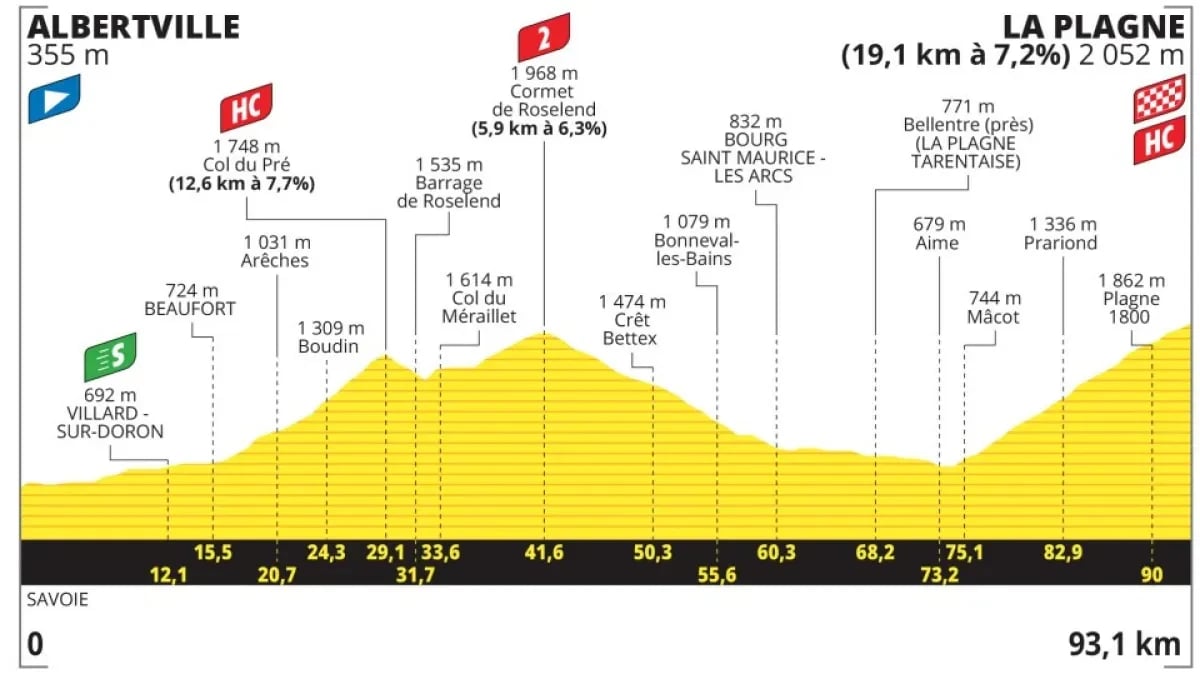
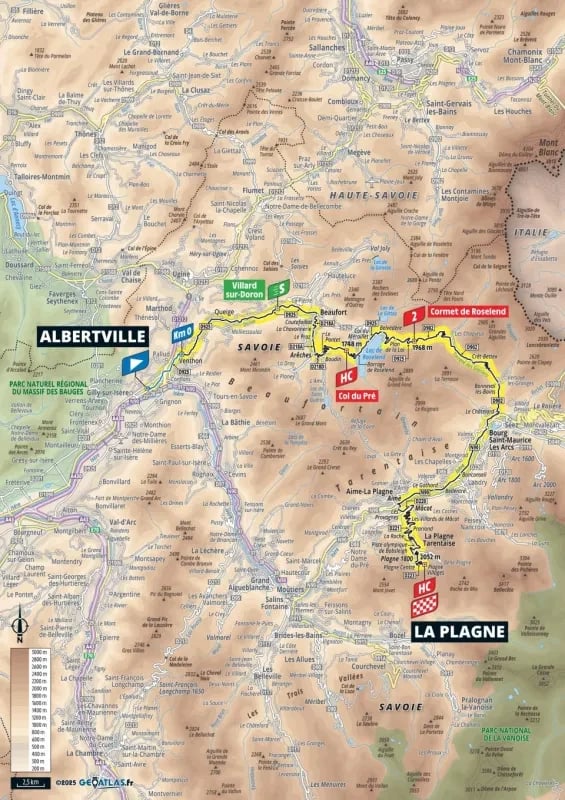
The stage was originally 129.9 kilometers long and included over 4,550 meters of elevation gain. Due to an outbreak of a contagious animal disease on the Col des Saisies, it was decided to cancel that climb as well as the Côte d’Héry-sur-Ugine.
| Date | Friday 25 July |
| Start |  Albertville Albertville |
| Finish | La Plagne |
| Distance | 93.1 km |
| Elevation gain | 3431 m |
| Start time | 14:30 |
| Expected finish | 17:18-17:46 |


Stage 19 Albertville - La Plagne (93.1km)
For the less good climbers, this is the hell of this Tour de France
Albertville was an unknown place in the sports world until the mid-eighties, until the 1992 Winter Olympics took place in this small town at the foot of the Alps. In several respects, this was a special event due to the many geopolitical shifts at that time: the Soviet Union had just fallen apart and the Berlin Wall had been broken open. Many current countries then participated for the first time under their own flag. Unthinkable now, but reality then: the Netherlands won only four skating medals.
Back to cycling. Possibly we have a regional de l'etape in this stage. EF Education-EasyPost rider Alex Baudin was born and raised in Albertville. The 24-year-old climber broke through definitively last autumn, with, among other things, a third place in the Tour of Guangxi. Provided his American employer calls him up AND he makes it to the final weekend, you can bet that Baudin will seek the attack from his birthplace.
Two days from Paris, the ASO has no fewer than five climbs in store for the riders. The worst of all: they are crammed into barely 131 kilometers. For all sprinters who still hope for a last straw in the capital, this stage is a nightmare. After barely seven kilometers, the first climb of the day is already on the menu, and from that moment on, the fast men and anti-climbers know that they're getting five courses in the battle against the time limit.
The first two are well-known Tour climbs: Col des Saisies and Col du Pré. Especially the last kilometers of this mountain pass are extremely steep. Cycling adventurers familiar with the region also know that cycling over this climb is a prerequisite toward the beautiful Cormet de Roselend. That name sounds like a bell for the Tour enthusiast, but not because of a dizzying gradient percentage or its length. The vast character and the rhododendrons often blooming in summer characterize this beautiful cycling and walking area. People often think that the climb also owes its name to the blooming, pink flowers. That's not true. It comes from the village of Roselend, which was sacrificed in 1960 for the benefit of the reservoir that is now there.
A small church next to the reservoir is all that remains of the village of yesteryear. Pray there especially, gentlemen cyclists. Because the descent from the Cormet du Roselend to Bourg-Saint-Maurice is notorious for its many hairpin bends. Several riders have tumbled into the ravine there in the past. Finally follows the final climb to La Plagne, 19.5 kilometers long with an average gradient of more than seven percent. In popular parlance, that's called a runner. It's also only the fifth time that the Tour finishes here. The late Laurent Fignon won in 1984 AND 1987, Alex Zülle was the best in 1995, and the much-praised solo by Michael Boogerd on the previous page ended in 2002 on La Plagne.