Stage 20 Nantua - Pontarlier (184.2km)
Another great chance for attackers to toast to their Tour
The breathtaking Lac de Nantua will form the backdrop for the opening shots of the TV broadcasts of the penultimate stage in the 2025 Tour de France. For many, it's an undiscovered gem when compared to the much larger, well-known, and nearby Lake Geneva. The border with Switzerland is thus not far from the beautiful lake of Nantua. The village of the same name, Nantua, hosts the start. It did so in the Tour once before.
The finish location Pontarlier has a much richer history in cycling. Every year, the Tour du Doubs finishes there, which was ridden this season in April. This race was established in 1934, and with a significant number of intervals, it has been held annually since 1998. Strangely enough, a Dutchman has never stood on the podium. On behalf of Belgium, Loïc Vliegen won the race in the corona year 2020 and Bert De Waele in 2003.
Another special fact by which you can recognize Pontarlier: the city was for a long time THE center of absinthe. This was partly due to the relocation of Swiss Pernod to Pontarlier. By the year 1900, absinthe was one of the most popular spirits in Europe. The taste is characterized by a blend of anise, wormwood, fennel, and other herbs. In 1915, however, it was banned because absinthe was said to have a hallucinogenic effect. At the beginning of this century, that was relegated to the realm of fables. Absinthe has been allowed again since 2005 - except in the United States - and in Pontarlier, you now again find various distilleries.
In 2009, the Tour last visited Pontarlier, then still a starting place. Now it is a finish location, just as in 2001. In that year, Erik Dekker was celebrating. He was part of a leading group of fourteen riders, who reached the finish with more than 35 minutes' advantage. Dekker outsmarted established names such as Servais Knaven, Marc Wauters, Stuart O'Grady, Sven Teutenberg, Jacky Durand, Bram de Groot, Ludo Dierckxsens, Ludovic Turpin, and the late Andrei Kivilev. The escapees won't get such an advantage now, although it does promise to be a stage for attackers again.
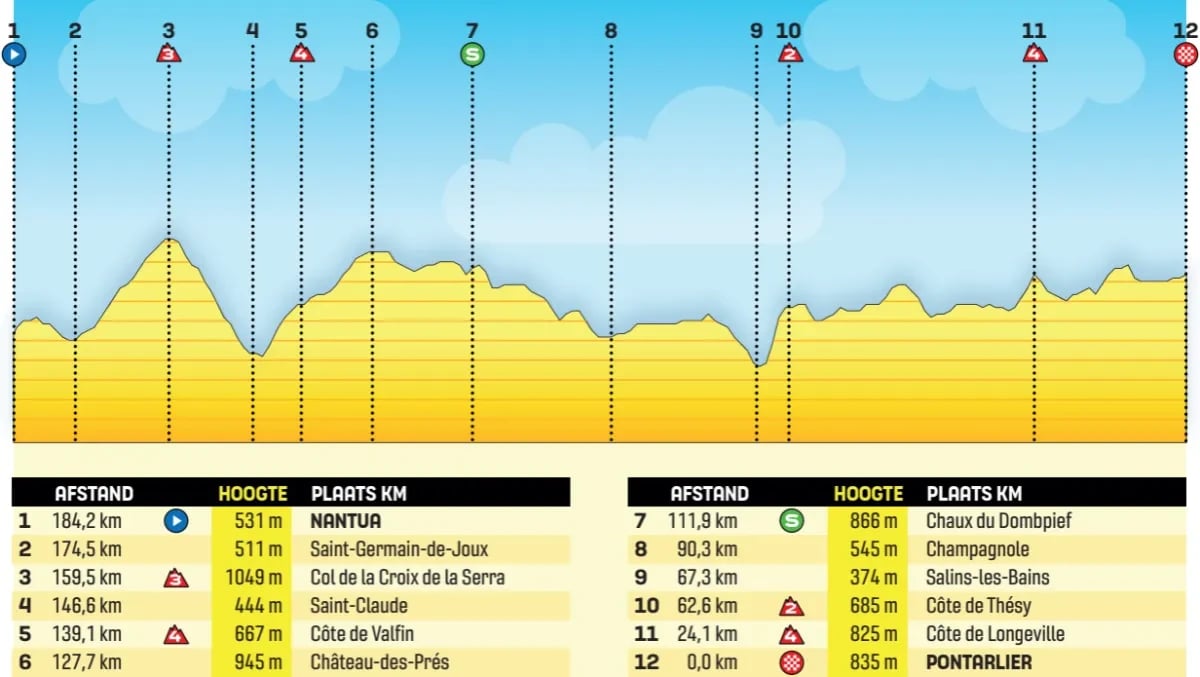
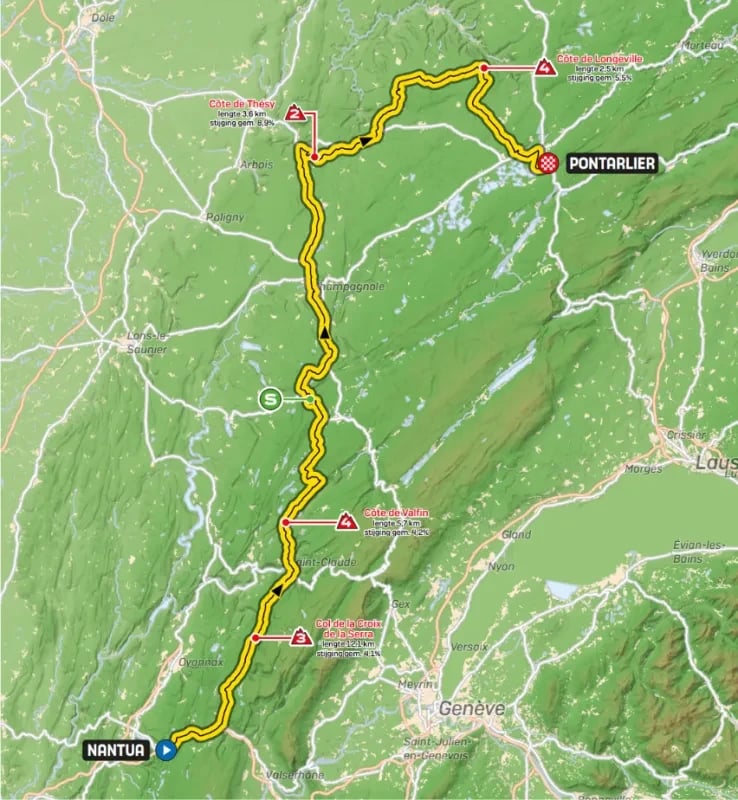
In the Jura, a stage has been designed with one col and four hills. During a difficult start in the first 25 kilometers, the best escapees from the Tour can distinguish themselves one more time. If they depart on the Col de la Croix de la Serra, they can make the difference in the last seventy kilometers. This begins with the extremely steep Côte de Thiesy (3.7 kilometers at a little under 9% average gradient). There the men distinguish themselves from the wimps. In the finale, there are two more hills where you can throw the competition overboard. Saving energy is the advice; the last hundreds of meters in Pontarlier rise unpleasantly, especially after three weeks of the Tour.
| Date | Saturday 26 July |
| Start |  Nantua Nantua |
| Finish | Pontarlier |
| Distance | 184.2 km |
| Elevation gain | 2900 m |
| Start time | 12:05 |
| Expected finish | 16:12-16:35 |


Stage 20 Nantua - Pontarlier (184.2km)
Another great chance for attackers to toast to their Tour
The breathtaking Lac de Nantua will form the backdrop for the opening shots of the TV broadcasts of the penultimate stage in the 2025 Tour de France. For many, it's an undiscovered gem when compared to the much larger, well-known, and nearby Lake Geneva. The border with Switzerland is thus not far from the beautiful lake of Nantua. The village of the same name, Nantua, hosts the start. It did so in the Tour once before.
The finish location Pontarlier has a much richer history in cycling. Every year, the Tour du Doubs finishes there, which was ridden this season in April. This race was established in 1934, and with a significant number of intervals, it has been held annually since 1998. Strangely enough, a Dutchman has never stood on the podium. On behalf of Belgium, Loïc Vliegen won the race in the corona year 2020 and Bert De Waele in 2003.
Another special fact by which you can recognize Pontarlier: the city was for a long time THE center of absinthe. This was partly due to the relocation of Swiss Pernod to Pontarlier. By the year 1900, absinthe was one of the most popular spirits in Europe. The taste is characterized by a blend of anise, wormwood, fennel, and other herbs. In 1915, however, it was banned because absinthe was said to have a hallucinogenic effect. At the beginning of this century, that was relegated to the realm of fables. Absinthe has been allowed again since 2005 - except in the United States - and in Pontarlier, you now again find various distilleries.
In 2009, the Tour last visited Pontarlier, then still a starting place. Now it is a finish location, just as in 2001. In that year, Erik Dekker was celebrating. He was part of a leading group of fourteen riders, who reached the finish with more than 35 minutes' advantage. Dekker outsmarted established names such as Servais Knaven, Marc Wauters, Stuart O'Grady, Sven Teutenberg, Jacky Durand, Bram de Groot, Ludo Dierckxsens, Ludovic Turpin, and the late Andrei Kivilev. The escapees won't get such an advantage now, although it does promise to be a stage for attackers again.
In the Jura, a stage has been designed with one col and four hills. During a difficult start in the first 25 kilometers, the best escapees from the Tour can distinguish themselves one more time. If they depart on the Col de la Croix de la Serra, they can make the difference in the last seventy kilometers. This begins with the extremely steep Côte de Thiesy (3.7 kilometers at a little under 9% average gradient). There the men distinguish themselves from the wimps. In the finale, there are two more hills where you can throw the competition overboard. Saving energy is the advice; the last hundreds of meters in Pontarlier rise unpleasantly, especially after three weeks of the Tour.