Stage 14 Pau - Saint-Lary-Soulan (Pla d'Adet) (151.9km)
Col du Tourmalet opens the finale with three giants
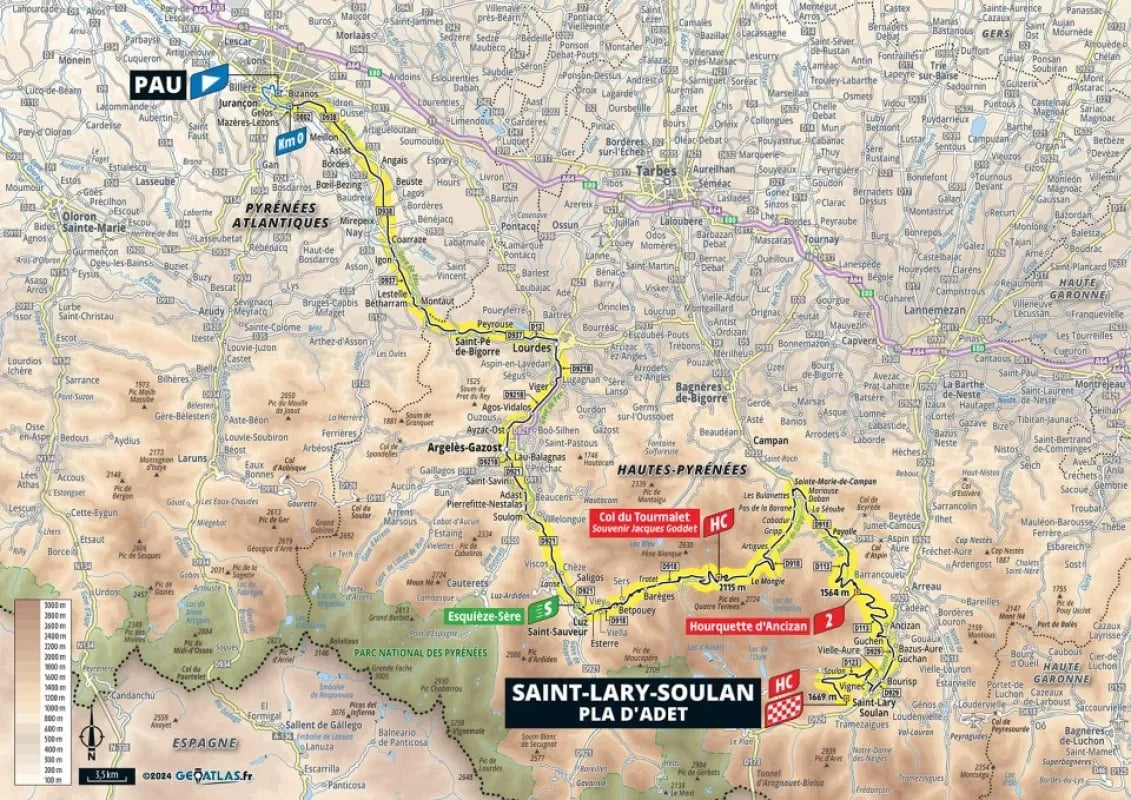
After patiently waiting, the riders find themselves on day fourteen of the Tour de France truly in the high mountains once again. The Pyrenees are conquered in a monstrous stage from Pau to Saint-Lary-Soulan, where the Pla d’Adet forms the climax of this leg. The Tourmalet and the Hourquette d’Ancizan are also on the menu, making it a day tailored for the contenders of the general classification.
Pau marked its 63rd Tour finish in stage thirteen and will add its 67th start to that tally in stage fourteen. Pau's location gives the ASO the perfect opportunity to set challenging Pyrenean stages, and this year is no exception.
This time, the race heads towards Saint-Lary-Soulan. The ski resort offers winter fun to many skiers and allows vacationers to relax in the village's thermal baths in the French Pyrenees. However, for Tour riders, it promises anything but rest. The village sits atop the Pla d’Adet, the final climb of the day.
In 1974, it was Mathieu van der Poel's grandfather, Raymond Poulidor, who triumphed on this giant. Later, other great names such as Joop Zoetemelk ('75), Lucien Van Impe ('76, '81), Mariano Martinez ('78), and Beat Breu ('82) also celebrated victories on this climb. The last time Pla d’Adet hosted a Tour finish was in 2014, with Rafal Majka emerging strongest from a breakaway. Fifty years after its debut in the Tour, Pla d’Adet makes its comeback in the Grand Boucle.
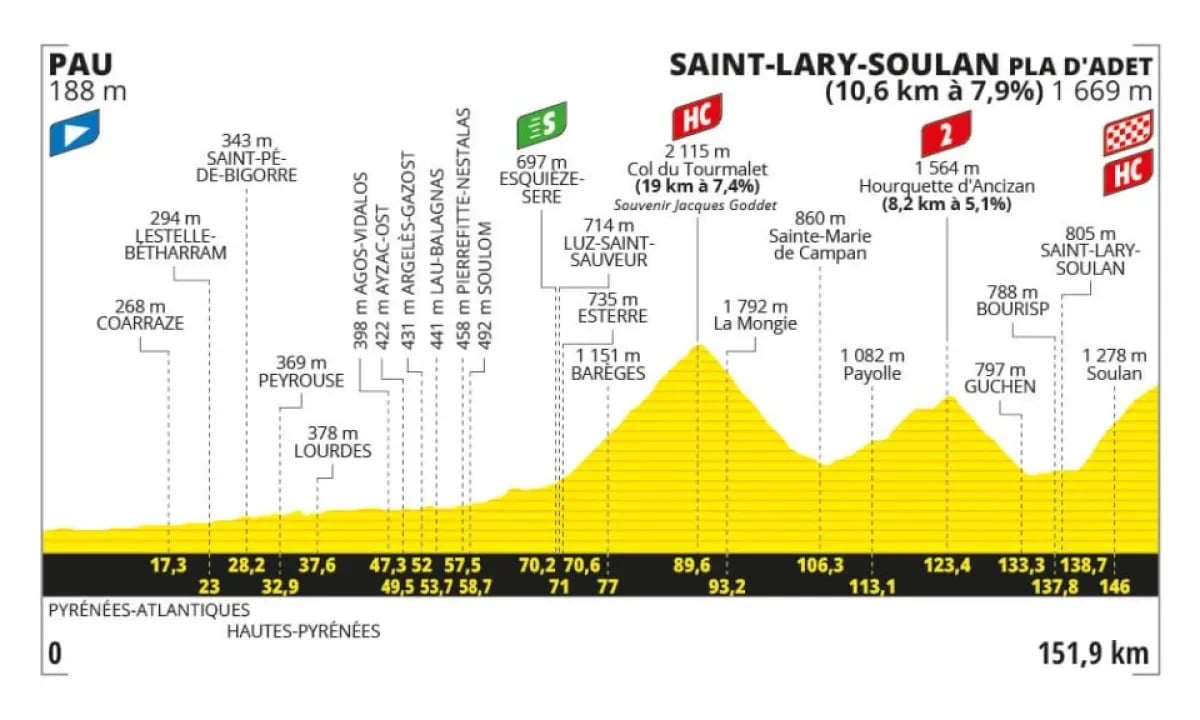
Before reaching there, the fourteenth stage starts with a calm approach of around seventy flat kilometers. This tranquility is abruptly shattered by the looming presence of the Col du Tourmalet (19 km at 7.4%). At the summit of this Tour classic, the Souvenir Jacques Goddet is awarded, a prize honoring the late Goddet. In 1931, he succeeded Henri Desgrange as the editor-in-chief of the French newspaper l’Auto, the publication that created the Tour de France. In 1939, Goddet took over as co-director of the Tour, a role he held until 1987, alongside Félix Lévitan from 1963 onwards. Post-World War II, Goddet was also instrumental in founding the globally renowned sports newspaper, l’Equipe. Atop the Tourmalet, a monument stands in his memory, commemorating his creation of the green jersey and the points classification in the Tour.
If the Tourmalet doesn’t shake up the standings, a rapid descent leads directly into the Hourquette d’Ancizan (8.2 km at 5.1%). After its summit, riders still face around thirty kilometers. The climbing isn’t over yet, as the final 10.6 kilometers ascend at an average of 7.9%. The Pla d’Adet begins with a punishing seven kilometers, frequently in double-digit gradients, followed by a brief flattening and even a descent. The final stretch of this arduous climb rises at nearly 9% gradient towards the finish line. Will someone deliver a decisive blow here?
| Date | Saturday 13 July |
| Start |  Pau Pau |
| Finish | Saint-Lary-Soulan (Pla d'Adet) |
| Distance | 151.9 km |
| Start time | 13:05 |
| Expected finish | 17:17 |
Stage 14 Pau - Saint-Lary-Soulan (Pla d'Adet) (151.9km)
Col du Tourmalet opens the finale with three giants
After patiently waiting, the riders find themselves on day fourteen of the Tour de France truly in the high mountains once again. The Pyrenees are conquered in a monstrous stage from Pau to Saint-Lary-Soulan, where the Pla d’Adet forms the climax of this leg. The Tourmalet and the Hourquette d’Ancizan are also on the menu, making it a day tailored for the contenders of the general classification.
Pau marked its 63rd Tour finish in stage thirteen and will add its 67th start to that tally in stage fourteen. Pau's location gives the ASO the perfect opportunity to set challenging Pyrenean stages, and this year is no exception.
This time, the race heads towards Saint-Lary-Soulan. The ski resort offers winter fun to many skiers and allows vacationers to relax in the village's thermal baths in the French Pyrenees. However, for Tour riders, it promises anything but rest. The village sits atop the Pla d’Adet, the final climb of the day.
In 1974, it was Mathieu van der Poel's grandfather, Raymond Poulidor, who triumphed on this giant. Later, other great names such as Joop Zoetemelk ('75), Lucien Van Impe ('76, '81), Mariano Martinez ('78), and Beat Breu ('82) also celebrated victories on this climb. The last time Pla d’Adet hosted a Tour finish was in 2014, with Rafal Majka emerging strongest from a breakaway. Fifty years after its debut in the Tour, Pla d’Adet makes its comeback in the Grand Boucle.
Before reaching there, the fourteenth stage starts with a calm approach of around seventy flat kilometers. This tranquility is abruptly shattered by the looming presence of the Col du Tourmalet (19 km at 7.4%). At the summit of this Tour classic, the Souvenir Jacques Goddet is awarded, a prize honoring the late Goddet. In 1931, he succeeded Henri Desgrange as the editor-in-chief of the French newspaper l’Auto, the publication that created the Tour de France. In 1939, Goddet took over as co-director of the Tour, a role he held until 1987, alongside Félix Lévitan from 1963 onwards. Post-World War II, Goddet was also instrumental in founding the globally renowned sports newspaper, l’Equipe. Atop the Tourmalet, a monument stands in his memory, commemorating his creation of the green jersey and the points classification in the Tour.
If the Tourmalet doesn’t shake up the standings, a rapid descent leads directly into the Hourquette d’Ancizan (8.2 km at 5.1%). After its summit, riders still face around thirty kilometers. The climbing isn’t over yet, as the final 10.6 kilometers ascend at an average of 7.9%. The Pla d’Adet begins with a punishing seven kilometers, frequently in double-digit gradients, followed by a brief flattening and even a descent. The final stretch of this arduous climb rises at nearly 9% gradient towards the finish line. Will someone deliver a decisive blow here?