
Stage 9 Troyes - Troyes (199.0km)
Gravel awaits on fourteen sectors in Aube
Prior to the first rest day, contenders in Troyes will nervously rise from their beds. On the second Sunday of the Tour de France, riders in a stage to and from Troyes will face fourteen "chemins blancs" (white roads) and conquer around 2000 meters of elevation gain. Out of the 199 kilometers, 32 will traverse dusty, unpaved paths, with half of these gravel sectors concentrated in the final fifty flat kilometers.
Troyes proudly serves as the capital of the Aube department, situated in the Champagne region. The city is surrounded by vineyards where grapes grow for the renowned celebratory drink. Riders must toil for another two weeks before they can indulge in the bubbly.
The Simon brothers, hailing from Troyes, understand this well. All four brothers were highly successful cyclists who reached the highest levels of the sport. Pascal ('82), Régis ('85), and Jérôme Simon ('88) each won stages in the Tour de France. The fourth brother, François, never won a stage but wore the yellow jersey in 2001, sharing that honor with Pascal, who wore the leader's jersey in 1983.
Where the Simon family achieved notable successes in La Grande Boucle, riders in the stage to and from Troyes hope to replicate such triumphs. The stage starts calmly, but after 47 kilometers, the first gravel section appears on the horizon. From Bligny to Bergères, riders traverse the initial chemin blanc, followed immediately by the Côte de Bergères (1.7 kilometers at 5.2%). The second gravel sector coincides with a climb, the Côte de Baroville (2.8 km at 4.8%).
Riders can then catch their breath briefly, which is much needed. Thirty kilometers later, after 95 kilometers in the saddle, they face the toughest part of the route. Within 35 kilometers, four gravel sectors and three climbs must be conquered. This challenging section begins with the Côte de Loches-sur-Ource (1.5 km at 5.2%), leading riders to the first sector. The next two chemins blancs both climb uphill, over the Côte de Val Frion (2.2 km at 5%) and the Côte de Chacenay (3 km at 4.3%). A final gently sloping gravel road concludes this part of the race.
With about seventy flat kilometers remaining, riders encounter seven more gravel sectors. The chemins blancs from Thieffrain to Magnant and from Briel-sur-Barse propel the dusty warriors into the final thirty kilometers. Here, six sectors await in just 25 kilometers. The last ten kilometers towards Troyes are on flat paved roads. Spring classics specialists will have marked this day in red, while contenders will aim to survive unscathed. In Aube, an exhausting battle awaits, where mishaps are just around the corner.

Stage 9 Troyes - Troyes (199.0km)
Gravel awaits on fourteen sectors in Aube
Prior to the first rest day, contenders in Troyes will nervously rise from their beds. On the second Sunday of the Tour de France, riders in a stage to and from Troyes will face fourteen "chemins blancs" (white roads) and conquer around 2000 meters of elevation gain. Out of the 199 kilometers, 32 will traverse dusty, unpaved paths, with half of these gravel sectors concentrated in the final fifty flat kilometers.
Troyes proudly serves as the capital of the Aube department, situated in the Champagne region. The city is surrounded by vineyards where grapes grow for the renowned celebratory drink. Riders must toil for another two weeks before they can indulge in the bubbly.
The Simon brothers, hailing from Troyes, understand this well. All four brothers were highly successful cyclists who reached the highest levels of the sport. Pascal ('82), Régis ('85), and Jérôme Simon ('88) each won stages in the Tour de France. The fourth brother, François, never won a stage but wore the yellow jersey in 2001, sharing that honor with Pascal, who wore the leader's jersey in 1983.
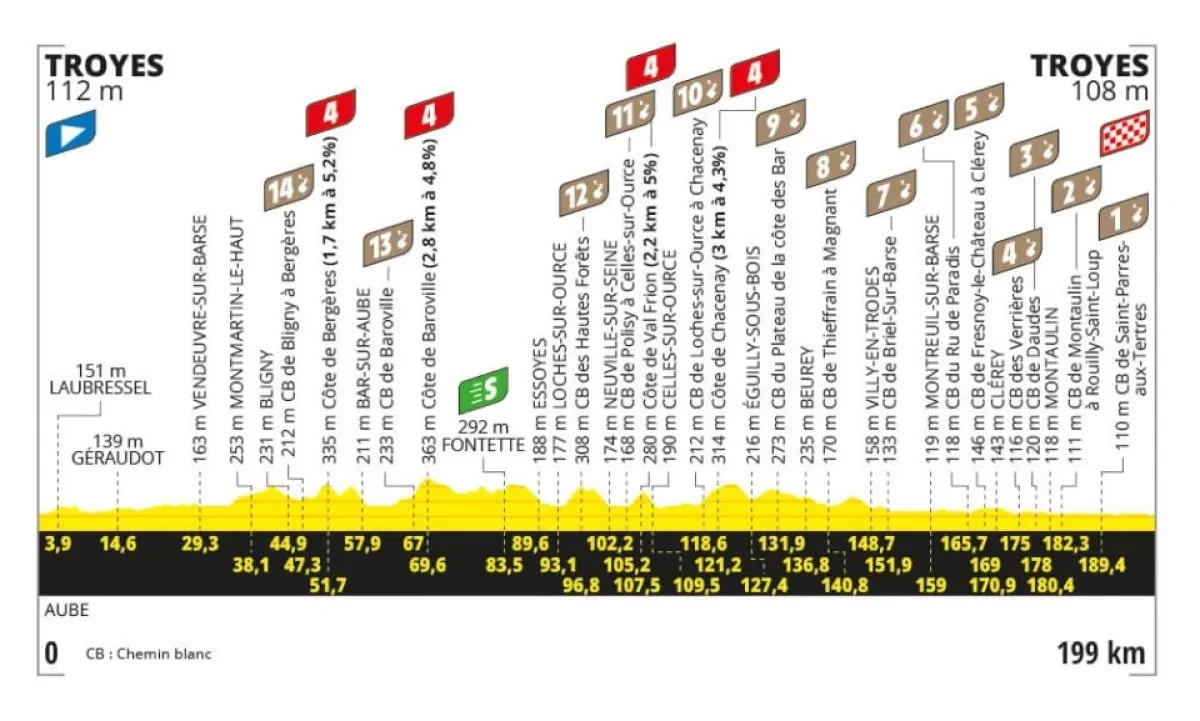
Where the Simon family achieved notable successes in La Grande Boucle, riders in the stage to and from Troyes hope to replicate such triumphs. The stage starts calmly, but after 47 kilometers, the first gravel section appears on the horizon. From Bligny to Bergères, riders traverse the initial chemin blanc, followed immediately by the Côte de Bergères (1.7 kilometers at 5.2%). The second gravel sector coincides with a climb, the Côte de Baroville (2.8 km at 4.8%).
Riders can then catch their breath briefly, which is much needed. Thirty kilometers later, after 95 kilometers in the saddle, they face the toughest part of the route. Within 35 kilometers, four gravel sectors and three climbs must be conquered. This challenging section begins with the Côte de Loches-sur-Ource (1.5 km at 5.2%), leading riders to the first sector. The next two chemins blancs both climb uphill, over the Côte de Val Frion (2.2 km at 5%) and the Côte de Chacenay (3 km at 4.3%). A final gently sloping gravel road concludes this part of the race.
With about seventy flat kilometers remaining, riders encounter seven more gravel sectors. The chemins blancs from Thieffrain to Magnant and from Briel-sur-Barse propel the dusty warriors into the final thirty kilometers. Here, six sectors await in just 25 kilometers. The last ten kilometers towards Troyes are on flat paved roads. Spring classics specialists will have marked this day in red, while contenders will aim to survive unscathed. In Aube, an exhausting battle awaits, where mishaps are just around the corner.